Digital Marketing Prospecting & Remarketing
What This Tutorial Covers
Prospecting Audiences
Reach new users similar to current customers.
Remarketing Lists
Re-engage past visitors with targeted ads.
Funnel Strategy
Different creative for different funnel stages.
Noble Desktop's Digital Marketing Certificate covers Google Ads, SEO, content marketing, analytics, and the full digital marketing stack.
We’ll talk about a two-pronged strategy to leverage digital marketing to drive your business forward. We’ll discuss two types of marketing, prospecting and remarketing, and think about how they can work together to create a full-funnel marketing campaign
Prospecting
Prospecting is the type of marketing where you go out and try to find potential customers who have never had any interaction with your business and may not even know what your business is. Think about a new startup with no brand recognition that needs to go out and find people who might be interested in your product or service. Even well-established companies can leverage prospect marketing to reach new segments of customers who they have not yet tapped into.
There are lots of options out there for prospecting in the digital marketing space. One of the more common and cost-effective strategies for prospect marketing is using social media marketing. This includes Facebook, Instagram, LinkedIn, and other social media, depending on where you think your customers are and what works best for your business. These tools can be used for both prospecting and remarketing, but we’ll start with the prospecting side of the house.
Tools for Prospecting
SEO: Showing up in the organic search results really pays off but getting there can be challenging. Ranking for relevant terms for your business can generate loads of traffic and new leads to your site. If you'd like to learn more about SEO and how to do it well, check out our SEO blog.
Google Ads: If you are willing to pay to show up in the search results a little more easily, then Google Ads could be a good option for generating quality traffic and leads to your site. To learn more about Google Ads, check out our Google Ads blog with tons of free articles like this to get you started.
Paid Social: If the search engine isn't your thing or people aren't really searching for your product or service, you can try paid marketing with social media. You can leverage Facebook, Instagram, LinkedIn, or whatever other platforms you think your prospects are on to reach them.
Organic Social: Building an organic social media following is challenging but if done well it can also pay off well. Find the right platform(s) for your audience, give them content they will engage with and share, and grow your social media following to generate leads.
Other Strategies: There are a handful of other strategies you can use to generate buzz and traffic to your site including influencer marketing, affiliate marketing, email marketing, and more.
Prospecting Example
Say we launched a new product today and want to reach a certain segment of the population to advertise our new product, we could start by launching some social media ads targeting specific groups of people who we think might be interested. If we are launching a new healthy snack for kids, we would probably want to target parents of children who are interested in health. The tools mentioned above all have ways to reach people based on interests and/or demographics like in our example.
Once we launch our campaign, we may notice that we are spending a lot of money on advertising but are not generating a ton of conversions. People are interested in the product and we are driving traffic to our site, but our conversion rates are really low. Remarketing…
Remarketing
Remarketing is marketing to customers who have already engaged with your business in some way. A common way to do this is to remarket to people who have visited your website. If we have our Facebook Pixel set up on our site then Facebook can tag people who have visited your site and put them into a remarketing list. The same goes for display advertising or even Google Ads. Now that we’ve driven all that traffic with our prospecting strategy, we want to make sure we can get those customers to come back to us and potentially convert.
They have already demonstrated interest by visiting our site but they may need some more time to think the purchase over or they may have forgotten completely. The demonstrated interest is why remarketing strategies tend to be a lot more profitable. You are going after a specified, generally smaller, group of people who are already familiar with your brand and have visited your site.
Tools for Remarketing/Retargeting
Google Ads: While Google Ads is known for its search functionality it also provides a great opportunity for remarketing. You can use remarketing lists within Google Ads to target site visitors and serve them ads around the web. To do this well, you'll need to create compelling ads and use precise targeting. Make as many remarketing lists as you need to make sure you are hitting different groups of visitors with the best possible ad. For example, if you offer multiple products, you'll probably want to serve an ad featuring the product they were looking at.
Paid Social: Similar to the way Google Ads works, you serve display ads to users who have visited your site and create custom audiences based on site visitors. The difference here is that instead of showing up on a variety of sites with Google Ads, you are showing up in whatever social media platform you choose to serve ads on. There are pro's and con's to this, and you could make a case that social media advertising is more or less effective than Google's display advertising when you account for the cost.
Email Marketing: This is probably the most cost-efficient and effective of remarketing methods, but also the most challenging. To be able to remarket via email you need to set up a way to collect email addresses on your site. You can offer free guides or free samples as a way to collect emails and then leverage those emails for email marketing. Email marketing is free and it should convert relatively well against other channels, but you need to get creative to collect lots of emails on your site.
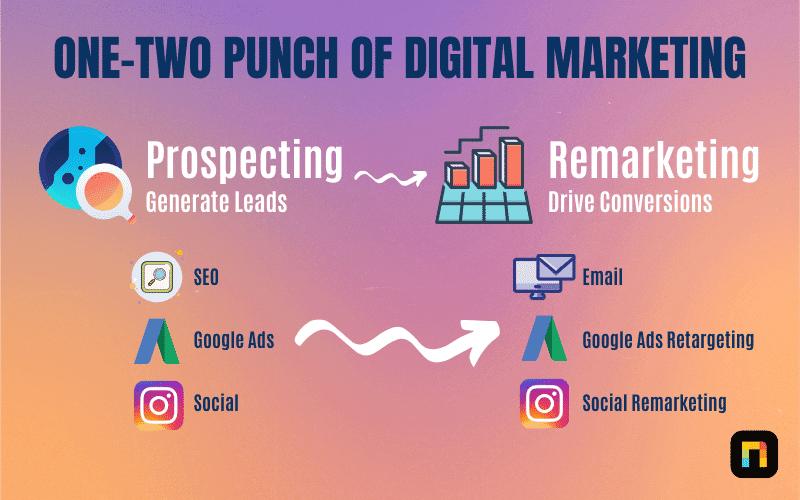
The One-Two Punch
We’ve talked about prospecting and remarketing as two types of marketing, but the true power is in the synergy of the two. In the example of our new healthy kids' snack, we may start pretty broadly with our prospecting strategy to generate interest and then close in our most interested targets with remarketing campaigns. Remarketing can amplify the success of our prospecting campaigns, and prospecting helps grow our remarketing lists. They work in tandem if done correctly. One way to think about marketing is like fishing. You go out there and throw some hooks, i.e., prospect marketing, and then you reel them in with a remarketing strategy.
Master Digital Marketing
Become a master of digital marketing with our hands-on digital marketing classes led by digital marketing experts.