5 Ways to Improve Your Google Ads Campaigns
What This Tutorial Covers
Keyword Match Types
Use exact, phrase, and broad match strategically.
Negative Keywords
Exclude irrelevant searches to save budget.
Quality Score
Improve relevance to lower cost-per-click.
Noble Desktop's Digital Marketing Certificate covers Google Ads, SEO, content marketing, analytics, and the full digital marketing stack.
In this article, we’ll discuss 5 ways to boost your paid search campaigns to drive better performance and grow your business. Search Engine Marketing, or paid search, is a digital channel full of opportunities.
Key Takeaways
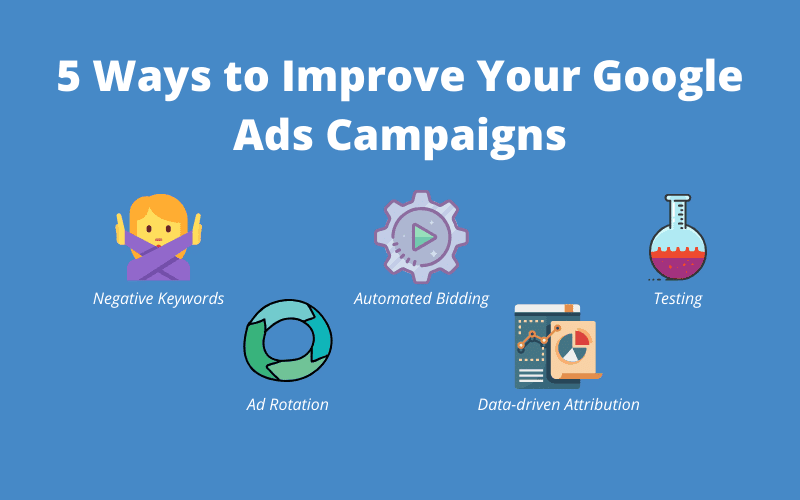
To get ahead in search, you need to focus on driving the most-efficient conversions by optimizing across various dimensions. A few highly-effective optimizations for Google Ads are leveraging negative keywords, ad rotation, automated bidding, data-driven attribution, and constant testing.
5 Tips for Google Ads
Despite being heavily text-based on the surface, there is a lot more going on behind the scenes of those text ads that can make or break your success in the paid search space. Assuming you are already up and running in your paid search campaigns, we’ll walk through 5 ways to bring your campaigns up a level.
1. Negative Keywords
Something that often gets overlooked or undermanaged are negative keywords lists. Say you have a broad match term like “+best +watches, ” you’d be surprised to learn just how much of your search volume is not very relevant to your business and how it drags down the performance of your overall campaign. If your business only sells adult men's watches then you will be disappointed to see lots of your impressions are for kids or women's watches. There are two primary reasons why negative keywords are especially beneficial.
The primary reason is that you will be spending money on clicks that will not convert for you, like in the case of someone clicking on your ad looking for a kid's watch and finding out that you don’t offer any.
The second reason is that it will drag down the overall performance of the campaign and could hurt your quality score.
The three factors of quality score are expected CTR, landing page experience, and ad relevance. If you show up for an ad when you don’t offer the product or service to match the customer’s need, they will either not click (CTR) or they will quickly bounce from your site (landing page experience), both of which can hurt your quality score. We generally recommend going through your search query reports at least once or twice a month to find any new negative keywords you should be adding. If you haven’t updated your negative keyword lists in a while, doing so will likely give your campaign a boost in terms of cost-savings and quality score improvements. See our article on negative keywords to learn more.
2. Ad Rotation
Ad copy is an art of its own, but thankfully Google and other ad platforms have tools to help you optimize your creative strategy. Your current ad groups may have 1 or 2 ads in there and you may not have updated those ads in a while. Updating your ad copy may be a good idea in general, and switching to ad rotation optimization may pay off even more in the long term.
Say we have 2 ads in our ad group and each one is getting 500 impressions a month, but one is strongly outperforming the other in clickthrough rate and conversion rate. While we could turn off the worse performing ad, this might be pretty time-consuming to do for all of our ad groups, which is where ad rotation optimization comes into play. This setting offered on Google Ads allows Google to automatically rotate between multiple to move towards the optimal frequency for each ad.
In our two-ad scenario, Google might shift to showing the better ad 75% of the time and the other ad 25% of the time to improve the overall performance of the ad group. You can also leverage this automation tool as a way to test more than just two pieces of ad copy. You can go ahead and throw 3 or 4 ads into the mix and see how they perform with the assurance that ad rotation will also optimize for overall performance.
Leveraging ad rotation optimization can take a lot of the load off of having to constantly manage ad copy and allow to test more pieces of ad copy more frequently. To start using this feature today you can toggle ad rotation optimization on at the individual ad group level or at the campaign level.
3. Automated Bidding
Another wonderful automation feature that Google and other ads platforms offer is automated bidding. Figuring out the right bids for each keyword in your account can be extremely difficult and trying to manage the ebbs and flows of competition and business cycles can make manual bidding very suboptimal. Thankfully we have automated bidding solutions that can make our lives a lot easier and our campaigns a lot more profitable.
Google’s Smart Bidding, the automated bidding solution, allows you to optimize towards many different goals depending on your desired outcome. You can set your bids to increase site visits, increase impression share, drive conversions at a specified CPA, and more. If you do opt for maximizing conversions or some other metric, make sure that you have a budget in place so your spending doesn’t get out of hand.
To start, it might be easier to use Target CPA or Target ROAS to make sure you are getting your desired return as you spend money. To learn more about the options available and how to set it up see Google’s guides for Smart Bidding.
4. Data-Driven Attribution
Most people start by setting up conversion tracking using a last-click method, which is probably advised to begin. As you get further into paid search you may want to start exploring other types of attribution methodologies depending on the nature of your business.
Let’s say you sell a high-priced item online like wedding rings where a customer would likely do a lot of research before buying, you wouldn’t expect the first search from that customer to result in a sale. The first search of the customer might be “best wedding rings” and then they might poke around various sites including yours but not make a purchase.
After visiting multiple sites and giving it some more thought, they decide that your offering was best so they search for your brand and make a purchase on your site.
In a last-click world, you might see your initial search ad as useless because that didn’t result in a sale, but you and I both know that had we not shown up for that initial search, the customer may have never learned about our brand and made the purchase. This is where other types of attribution can be beneficial.
Google offers a report and tool called Data-Driven Attribution where you can see the difference in conversions between the last-click methodology and Google’s data-driven methodology. To set up data-driven attribution for your account you can go to Tools > Conversions > Edit Settings > Attribution Model > Data-driven attribution. To learn more, see Google’s guide to Data-Driven Attribution.
5. Testing
Our first four recommendations were specific to a feature or function in the paid search arena, but our fifth one is a broader recommendation to improve the performance of your campaigns. The fifth recommendation is to test more across all dimensions of paid search.
By testing different things in your account, you will learn new things about your customers and new ways to optimize paid search specific to your account. While one type of ad or landing page will work better for one account, the opposite type might work for another. The only way to learn things specific to your audience and business is to test.
You can leverage Google’s Draft & Experiments feature to create tests or whatever search tool you use. We recommend running larger tests at least once a quarter and have smaller tests running more frequently.
An example of smaller tests that may run more frequently is ad copy using ad rotation as we mentioned above. Using ad rotation to test new ad copy is a low fidelity way to continuously test and improve your ad copy.
An example of a larger test that may require a tool like Drafts & Experiments is a landing page test, which requires more resources to create a new landing page, design the test, and launch the test.
Testing landing pages, ad copy, audience lists, and other things is a great way to glean new insights and drive your business forward.
Become a Digital Marketing Expert
These are a couple of actionable ideas for optimizing and improving your paid search campaigns. To learn more see our related course offerings