April 1, 2026Dan Rodney/2 min read

Layout View: Navigating, Zooming, Etc.

Master Layout View Navigation and Zoom Controls

Essential Layout View Functions

Zoom Control

Magnify specific areas or get overview perspective using tools or keyboard shortcuts. Essential for detailed design work and overall layout assessment.

Page Navigation

Move smoothly around your document using hand tool or keyboard combinations. Enables efficient workflow without constant tool switching.

Multi-Page Access

Quick jumping between document pages using menu controls. Streamlines navigation in complex multi-page layouts and publications.

Layout View: Navigating, Zooming, Etc.

Mastering navigation in the Layout view is essential for efficient document review and editing. This view provides the most accurate representation of how your content will appear in its final form, making precise navigation crucial for professional work.

Zooming in & Out

Effective zoom control allows you to seamlessly shift between detailed editing and comprehensive document overview, enhancing both precision and productivity.

Using the Tool:

Select the Zoom tool zoom tool and:

To zoom in: Click directly on any element you want to examine more closely. The view will center and magnify around your click point, allowing for precise detail work.
To zoom out: Hold Option (Mac) or ALT (Windows) and click anywhere on-screen to pull back for a broader perspective.

Using Keystrokes:

For rapid zoom adjustments without switching tools, these keyboard shortcuts are indispensable for maintaining workflow momentum:

Zoom in: Command–Plus(+) (Mac) or Control–Plus(+) (Windows)
Zoom out: Command–Minus(-) (Mac) or Control–Minus(-) (Windows)

Zoom Tool Method

1

Select Zoom Tool

Activate the zoom tool from your toolbar to begin magnification control

2

Click to Zoom In

Click directly on any element you want to see larger on screen for instant magnification

3

Hold Modifier to Zoom Out

Hold Option on Mac or ALT on Windows while clicking to reduce magnification level

Zoom Methods Comparison

FeatureTool MethodKeyboard Method
Zoom InClick with Zoom toolCommand/Control + Plus
Zoom OutOption/ALT + ClickCommand/Control + Minus
SpeedRequires tool selectionInstant from any tool
PrecisionClick exact target areaFixed increment levels
Recommended: Use keyboard shortcuts for speed, zoom tool for precision targeting

Scrolling Around a Page

Smooth document navigation is critical when working with complex layouts or lengthy publications. These methods ensure you can move efficiently through your content without losing your place or disrupting your editing flow.

Using the Tool:

Select the Hand tool hand tool and drag on the document to scroll. This method provides intuitive, tactile control over document positioning, particularly useful when you need to examine relationships between distant page elements.

Using a Keystroke:

While in the Type tool type tool, you can hold Option (Mac) or ALT (Windows) and drag on the document to scroll. This approach eliminates the need to constantly switch to the Hand tool hand tool, significantly streamlining your workflow during intensive editing sessions.

Efficient Scrolling Technique

While using the Type tool, hold Option on Mac or ALT on Windows and drag to scroll without switching to Hand tool. This maintains your workflow continuity and saves time during text editing sessions.

Hand Tool vs Keyboard Scrolling

Pros
Hand tool provides dedicated scrolling mode
Keyboard method works without tool switching
Option/ALT drag maintains current tool selection
Both methods offer smooth document navigation
Cons
Hand tool requires switching from current tool
Keyboard method requires holding modifier key
May accidentally trigger other functions if modifier released

Viewing Other Pages

When working with multi-page documents, efficient page navigation becomes crucial for maintaining editorial oversight and ensuring consistency across your publication.

Besides scrolling to view other pages, at the bottom left of the screen you can click the pages menu button button to open page menu and choose a different page (shown below). This method is particularly valuable when jumping to non-sequential pages or when you need to quickly reference specific sections of lengthy documents.
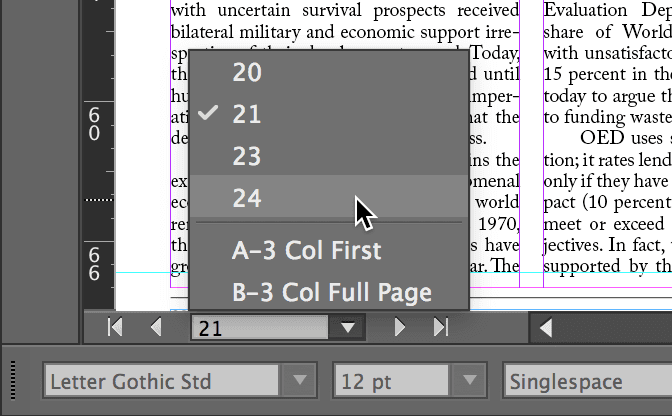
change pages using menu

Page Navigation Options

1

Scroll Method

Use standard scrolling techniques to move between pages in continuous view

2

Page Menu Access

Locate the pages menu button at bottom left of your screen interface

3

Direct Page Selection

Click the pages menu and choose specific page for immediate navigation

Layout Navigation Mastery

0/5

Key Takeaways

1Layout view offers multiple zoom methods including tool-based clicking and keyboard shortcuts for different precision needs
2Zoom in by clicking target areas with zoom tool or using Command/Control plus keyboard combinations
3Zoom out requires Option/ALT modifier with zoom tool or Command/Control minus keyboard shortcuts
4Hand tool provides dedicated scrolling capability by dragging document in any direction
5Option/ALT drag scrolling works while using Type tool without requiring tool switching
6Page navigation combines traditional scrolling with dedicated page menu controls at bottom left
7Keyboard shortcuts generally provide faster workflow than tool switching for zoom operations
8Understanding multiple navigation methods enables efficient layout design workflows and reduces time spent switching between tools

RELATED ARTICLES