March 23, 2026/1 min read

SQL WHERE Tutorial

Master SQL data filtering with WHERE statements

SQL WHERE Statement Fundamentals

Data Filtering

WHERE statements allow you to retrieve only the records that meet specific conditions. This reduces processing time and returns more relevant results.

Condition Logic

Conditions can include comparison operators, logical operators, and pattern matching. The WHERE clause evaluates each record against your criteria.

Query Performance

Proper use of WHERE clauses improves database performance by limiting the amount of data processed and transferred from the database.

SQL Syntax Foundation

The basic syntax structure SELECT * FROM table WHERE condition forms the foundation of most SQL data retrieval operations.

WHERE Statement

  • The WHERE statement is the fundamental filtering mechanism in SQL, enabling precise data extraction from tables by specifying exact criteria that records must satisfy.

  • It establishes conditional logic that determines which rows qualify for retrieval, transforming broad datasets into targeted, actionable information.

  • Syntax: SELECT * FROM table WHERE condition

WHERE Statement Construction

1

Start with SELECT

Begin your query with SELECT followed by the columns you want to retrieve, or use asterisk for all columns.

2

Specify the table

Use FROM followed by the table name to indicate which table contains the data you want to filter.

3

Add WHERE condition

Include the WHERE keyword followed by your condition that records must meet to be included in results.

4

Execute the query

Run your query to retrieve only the records that satisfy your specified condition criteria.

Common WHERE Operators Usage

Equality (=)
35
Comparison (>, <)
25
Range (BETWEEN)
20
Pattern (LIKE)
15
Null checks
5

Example

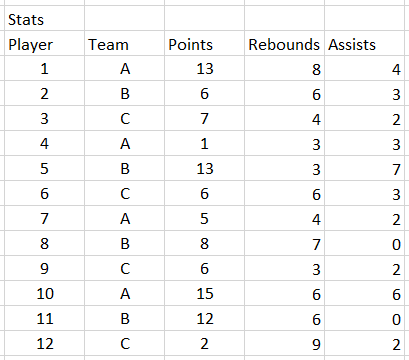
Let's examine a practical scenario using a basketball league database where we maintain comprehensive player records, including team affiliations and performance metrics. This type of structured data analysis is common across industries—from sports analytics to business intelligence reporting.

Stats Table

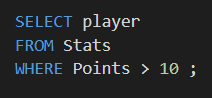
To demonstrate the WHERE statement's filtering capabilities, suppose we need to identify high-performing players who have scored more than 10 points. This type of query is essential for performance evaluation, roster decisions, and statistical analysis. We would construct the following SQL query:

SQL WHERE statement

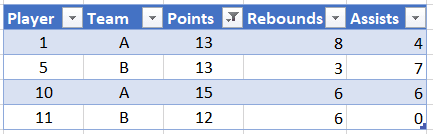
Executing this query filters our dataset to return only records meeting our specified criteria. The result demonstrates how WHERE statements transform raw data into meaningful insights:

SQL WHERE Result

Basketball League Example Breakdown

Table Structure

The basketball league database contains player records with team assignments and basic statistics including points scored per player.

Filter Condition

Using the condition for more than 10 points demonstrates numerical comparison filtering to identify high-performing players in the league.

WHERE Statement Best Practices

0/4
Query Execution Result

After running the basketball player query with the points condition, the result displays only players who scored more than 10 points, demonstrating effective data filtering.

Key Takeaways

1WHERE statements filter database records by applying conditions that must be met for data retrieval
2The basic syntax structure combines SELECT, FROM, and WHERE keywords to create filtered queries
3Conditions can use various operators including equality, comparison, and range operators for flexible filtering
4Basketball league example demonstrates practical application of numerical comparison filtering for player statistics
5Proper WHERE clause implementation improves query performance by reducing processed data volume
6Testing conditions with sample data ensures accurate results before production database queries
7Understanding data types and column structure is essential for creating effective WHERE conditions
8WHERE statements form the foundation for more advanced SQL operations and complex data analysis

RELATED ARTICLES