March 23, 2026/9 min read

Best Python Classes Online

Master Python Programming with Top Online Learning Platforms

Python Learning Platform Pricing Comparison

$25
DataCamp monthly (billed yearly)
$29
Dataquest monthly subscription
$1,999
Codecademy monthly access
$2,999
LinkedIn Learning monthly

5 Ways to Learn Python Online Graphic

Summary: Top 5 Ways to Learn Python Online

  1. DataCamp: DataCamp delivers an intuitive, interactive platform specifically designed for learning Python in data science contexts. Their hands-on approach includes a free introductory course to get you started.

  2. Dataquest: A compelling alternative that emphasizes self-paced, interactive learning with real-world data science projects and career-focused skill development.

  3. Codecademy: A comprehensive platform offering interactive programming instruction across multiple languages, with particularly strong Python fundamentals courses that build solid coding foundations.

  4. Online Learning Platforms: Major educational platforms including LinkedIn Learning, edX, Coursera, Udemy, and Udacity provide extensive video-based Python courses, ranging from beginner to advanced levels with professional certifications.

  5. Live Online Training: For learners seeking structured guidance, live online instruction combines the convenience of remote learning with real-time instructor support, peer interaction, and built-in accountability.

Continue reading for a comprehensive analysis of Python's growing importance, detailed reviews of each learning platform, and additional resources to accelerate your Python mastery.

Free Learning Opportunity

Get started with Python and data science through a completely free 1-hour seminar that covers Python basics, data science applications, and essential tools needed to begin your journey.

Interactive Learning Platforms Comparison

FeatureDataCampDataquestCodecademy
Monthly Cost$25/mo$29/mo$19.99/mo
Focus AreaData ScienceData AnalyticsGeneral Programming
Setup RequiredNoneNoneNone
Learning StyleInteractiveInteractiveInteractive
Free TrialYesAvailableYes
Recommended: Choose DataCamp for data science focus, Dataquest for analytics emphasis, or Codecademy for broader programming skills.

Live Online Training vs Self-Paced Learning

Pros
Real-time instructor support and personalized attention
Increased accountability with scheduled classes and peer interaction
Immediate help when encountering coding problems
Community engagement and collaborative learning environment
Higher course completion rates compared to self-paced options
Cons
Less flexibility in scheduling and learning pace
Higher cost compared to self-paced alternatives
Fixed class times may not suit all schedules
Limited ability to revisit material at your own speed

Why Learn Python

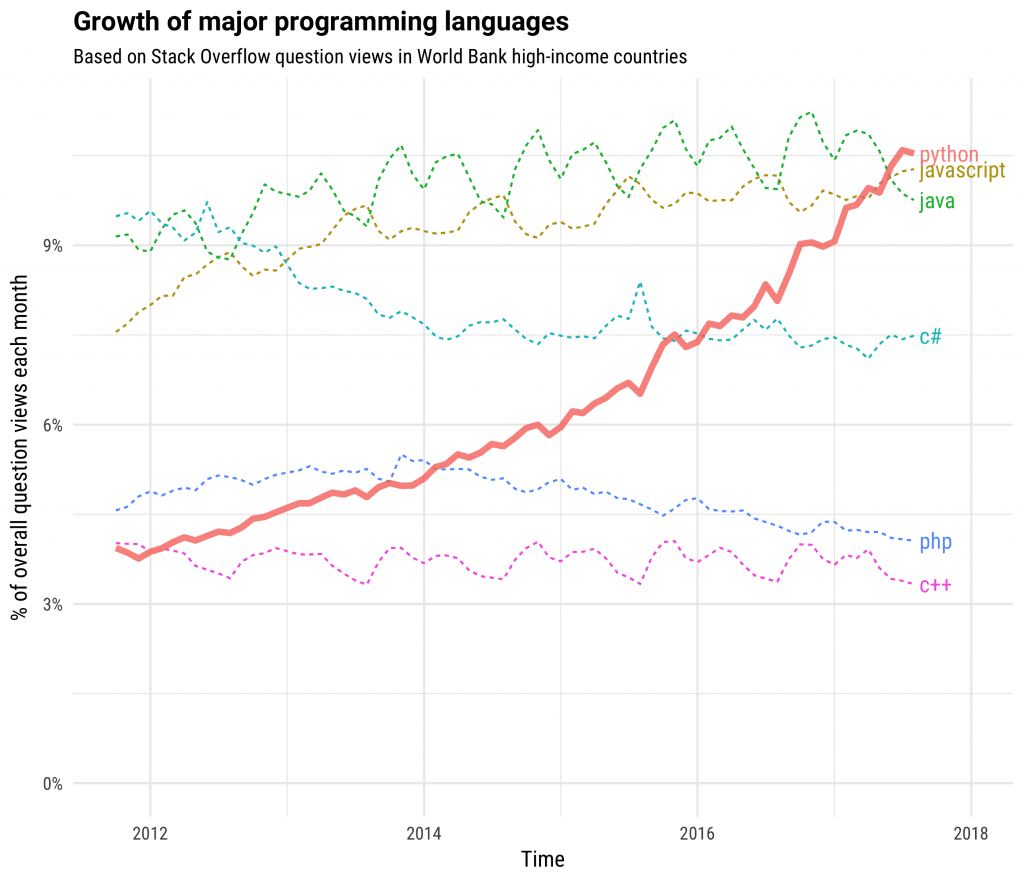
Python's dominance in the programming landscape has only intensified since 2020. According to Stack Overflow's annual developer survey, Python consistently ranks as one of the most beloved and sought-after programming languages, with professionals across industries expressing strong preference for Python-based roles. This isn't merely a trend—it represents a fundamental shift in how businesses approach technology and data.

Python Growth Stack Overflow

Source: Stack Overflow.blog

The TIOBE Programming Community Index reflects this growth trajectory, with Python maintaining its position among the top three programming languages globally. What makes this particularly significant is Python's adoption rate in enterprise environments—major corporations from Netflix to NASA rely on Python for critical operations. Furthermore, academic institutions worldwide have standardized Python as their primary introductory programming language, ensuring a pipeline of Python-literate professionals entering the workforce.

Rise of Big Data

The exponential growth in data generation—from IoT devices, social media platforms, financial transactions, and digital interactions—has created unprecedented demand for professionals who can extract meaningful insights from complex datasets. Python has emerged as the lingua franca of data science because it uniquely addresses the diverse challenges of modern data work.

Consider the scale: global data creation reached 120 zettabytes in 2023 and continues expanding exponentially. Organizations across sectors—from healthcare systems analyzing patient outcomes to retail companies optimizing supply chains—require robust tools for data manipulation, analysis, and machine learning deployment. Python's ecosystem provides unmatched capabilities in this environment through its combination of:

  • Modern software infrastructure that scales from prototype to production

  • A vast open-source ecosystem with over 400,000 packages available

  • Clean, readable syntax that reduces development time and maintenance costs

Python Versus

Python's competitive advantages become clear when compared to traditional business intelligence tools. While Excel remains valuable for quick analysis and reporting, Python offers superior scalability, automation capabilities, and advanced analytical functions—advantages we explore thoroughly in our Python vs. Excel comparison.

Unlike point-and-click tools such as Tableau, Python enables complete workflow automation, custom algorithm development, and seamless integration with diverse data sources. Professional analysts who transition to Python report dramatic improvements in productivity—handling datasets that would crash Excel, creating automated reporting pipelines, and building predictive models that drive strategic decision-making. Once professionals experience Python's power for data manipulation, statistical analysis, and machine learning, they rarely return to legacy tools for complex analytical work.

Python's Rising Popularity

According to Stack Overflow's most recent survey, Python is the most wanted programming language for the second year running. More developers want to work with Python than any other language.

What Makes Python Unique

Modern Infrastructure

Python combines cutting-edge software infrastructure with powerful data manipulation capabilities. It offers scalability and automation that traditional tools cannot match.

Open Source Community

Python benefits from a broad, active open-source community that continuously develops libraries and tools. This community support accelerates learning and problem-solving.

Readable Code

Python's syntax emphasizes readability and simplicity, making it accessible for beginners while remaining powerful for advanced applications. Code is concise and intuitive.

Python Online

The maturation of online education technology has created unprecedented opportunities for learning Python effectively from anywhere. Today's platforms offer sophisticated interactive environments, real-world project portfolios, and community support that rivals traditional classroom instruction. The COVID-19 pandemic accelerated innovation in online learning, resulting in more engaging, practical, and career-focused Python education options.

Modern online Python courses incorporate industry best practices, current libraries and frameworks, and real business scenarios. Many platforms now offer direct pathways to employment, with hiring partners actively recruiting from course graduates. Whether you're a complete programming beginner or an experienced professional adding Python to your skill set, today's online options provide flexible, comprehensive pathways to proficiency.

For a comprehensive introduction to Python's applications in data science, including career prospects and getting started guidance, explore our complimentary 1-hour seminar: Get Started in Python for Data Science.

Free Learning Opportunity

Get started with Python and data science through a completely free 1-hour seminar that covers Python basics, data science applications, and essential tools needed to begin your journey.

Interactive Learning Platforms Comparison

FeatureDataCampDataquestCodecademy
Monthly Cost$25/mo$29/mo$19.99/mo
Focus AreaData ScienceData AnalyticsGeneral Programming
Setup RequiredNoneNoneNone
Learning StyleInteractiveInteractiveInteractive
Free TrialYesAvailableYes
Recommended: Choose DataCamp for data science focus, Dataquest for analytics emphasis, or Codecademy for broader programming skills.

Live Online Training vs Self-Paced Learning

Pros
Real-time instructor support and personalized attention
Increased accountability with scheduled classes and peer interaction
Immediate help when encountering coding problems
Community engagement and collaborative learning environment
Higher course completion rates compared to self-paced options
Cons
Less flexibility in scheduling and learning pace
Higher cost compared to self-paced alternatives
Fixed class times may not suit all schedules
Limited ability to revisit material at your own speed

Top 5 Ways to Learn Python Online

1. DataCamp

DataCamp has established itself as a premier destination for data science education, with over 11 million learners worldwide using their platform. Their approach centers on immediate application—every concept is reinforced through hands-on exercises using real datasets from companies like Netflix, Tesla, and the World Health Organization.

The platform's strength lies in its carefully structured learning paths that guide students from basic Python syntax through advanced machine learning concepts. Each lesson includes integrated coding exercises that run directly in your browser, eliminating setup friction and allowing immediate focus on learning. Their error messaging system provides contextual help, while community forums enable peer collaboration on challenging problems.

DataCamp's career tracks align with industry demands, covering specializations like Data Scientist, Data Analyst, and Machine Learning Scientist. Their skill assessments and certificates are increasingly recognized by employers as indicators of practical competency.

Begin your journey with their comprehensive Python for Data Science introduction, which covers pandas, matplotlib, and statistical analysis fundamentals.

  • Ease of Use: Zero setup required, beginner-friendly interface with progressive difficulty

  • Pricing: $25/month billed annually (basic plan), with frequent promotional pricing available

2. Dataquest

Dataquest differentiates itself through project-centric learning that mirrors real-world data science workflows. Rather than isolated exercises, students work through complete analytical projects—from data collection and cleaning through analysis and presentation. Recent projects include analyzing Airbnb pricing data, building recommendation systems, and creating predictive models for stock prices.

The platform emphasizes command-line proficiency and version control (Git), skills often overlooked in other online courses but essential for professional data science work. Their guided projects culminate in a portfolio that demonstrates practical competency to potential employers. Data analytics concepts are taught within business contexts, helping students understand not just how to manipulate data, but why specific analytical approaches matter for decision-making.

Dataquest's community includes active career support, with mentorship programs and job placement assistance for premium subscribers.

  • Ease of Use: Browser-based environment with integrated project management tools

  • Pricing: $49/month for premium features; $39/month when billed annually

3. Codecademy

Codecademy excels at building strong programming fundamentals through their interactive curriculum design. Their Python courses emphasize software engineering principles, making them ideal for learners interested in both data science applications and general software development. The platform's strength lies in comprehensive coverage of Python syntax, data structures, and algorithmic thinking.

Recent curriculum updates include modern Python practices like f-strings, type hints, and asynchronous programming. Their Python classes integrate seamlessly with web development tracks, enabling learners to build full-stack applications. For professionals considering broader programming careers, Codecademy's cross-language approach facilitates learning JavaScript, SQL, and other complementary technologies.

The platform's Pro features include real-world projects, peer code reviews, and career services including resume review and interview preparation.

  • Ease of Use: Intuitive interface with immediate code execution and feedback

  • Pricing: $15.99/month for Pro features; free tier available with limited content

4. Online Learning Aggregators

Major educational platforms have significantly enhanced their Python offerings, with many courses now taught by industry practitioners from Google, IBM, and other leading technology companies. These platforms excel at providing depth and specialization, with courses ranging from beginner fundamentals to advanced topics like deep learning and natural language processing.

The video-based format allows for detailed explanations of complex concepts, while many courses include downloadable resources, datasets, and code templates. However, learners should expect more self-direction and technical setup compared to interactive platforms.

  • EdX: Features university-level courses from MIT, Harvard, and other prestigious institutions. Their MicroMasters programs in data science provide graduate-level education with academic credit options. Notable offerings include MIT's "Introduction to Computational Thinking and Data Science" and Microsoft's professional certificate programs.

  • LinkedIn Learning: Integrates directly with LinkedIn profiles, allowing completed courses to display as professional credentials. Their business focus means courses often address specific industry applications. Popular offerings include "Python for Data Science Essential Training" and specialized tracks in financial analysis and marketing analytics. Subscription includes access to business, creative, and technology courses across their entire catalog.

  • Other leading platforms include Coursera (featuring Google Career Certificates and university partnerships), Udemy (with frequently updated courses from industry practitioners), and Udacity (known for their Nanodegree programs with Python programming career guarantees)

5. Live Online Training

Live online instruction addresses the primary weakness of self-paced learning: completion rates. Industry research shows that self-directed online courses have completion rates below 15%, while instructor-led training achieves completion rates above 85%. For professionals investing in career development, this difference is crucial.

Modern live online platforms use breakout rooms, collaborative coding environments, and real-time polling to create engaging virtual classroom experiences. The synchronous format enables immediate clarification of concepts, personalized feedback on code, and peer learning through shared problem-solving.

Accountability

The social commitment of joining scheduled sessions with peers creates powerful accountability mechanisms. Students report that knowing classmates and instructors expect their participation dramatically increases follow-through. Additionally, many programs include homework review and progress check-ins that maintain momentum between sessions.

Instructor Help

Experienced instructors provide invaluable guidance on best practices, common pitfalls, and industry applications that recorded courses cannot match. They adapt explanations to different learning styles, provide debugging assistance, and share practical insights from professional experience. This personalized attention accelerates learning and helps students develop professional coding habits from the beginning.

Community & Engagement

Live cohort-based learning creates lasting professional networks. Many students form study groups, collaborate on projects beyond the course, and maintain connections that benefit their careers long-term. The energy of real-time collaboration, shared discoveries, and group problem-solving enhances retention and makes learning more enjoyable.

Noble Desktop delivers comprehensive, career-focused Python training through live online instruction. Our intensive Python for Data Science Bootcamp ($1,595) provides complete training from fundamentals through advanced analytics, while our Python in a Day intensive ($325) offers rapid skill acquisition for busy professionals. Explore our complete Python curriculum for programs tailored to different experience levels and career goals.

Free Learning Opportunity

Get started with Python and data science through a completely free 1-hour seminar that covers Python basics, data science applications, and essential tools needed to begin your journey.

Interactive Learning Platforms Comparison

FeatureDataCampDataquestCodecademy
Monthly Cost$25/mo$29/mo$19.99/mo
Focus AreaData ScienceData AnalyticsGeneral Programming
Setup RequiredNoneNoneNone
Learning StyleInteractiveInteractiveInteractive
Free TrialYesAvailableYes
Recommended: Choose DataCamp for data science focus, Dataquest for analytics emphasis, or Codecademy for broader programming skills.

Live Online Training vs Self-Paced Learning

Pros
Real-time instructor support and personalized attention
Increased accountability with scheduled classes and peer interaction
Immediate help when encountering coding problems
Community engagement and collaborative learning environment
Higher course completion rates compared to self-paced options
Cons
Less flexibility in scheduling and learning pace
Higher cost compared to self-paced alternatives
Fixed class times may not suit all schedules
Limited ability to revisit material at your own speed

Other Free Resources

  • Learn Python—Free Interactive Python Tutorial: Comprehensive hands-on exercises covering Python fundamentals through advanced topics

  • 10 Free Courses from Hackernoon: Curated collection of high-quality Python courses from leading developers and educators

  • Noble Python Blog—Professional tutorials, career guidance, and practical Python applications with regular updates on industry trends and best practices

Free Python Learning Resources

Interactive Tutorial

Learn Python offers a free interactive tutorial that teaches Python fundamentals through hands-on exercises. Perfect for complete beginners who want to start coding immediately.

Hackernoon Courses

Access 10 free comprehensive Python courses covering various aspects of the language. These courses range from basic syntax to advanced programming concepts.

Noble Python Blog

Explore free articles, resources, and detailed tutorials specifically designed to help you master Python. Regular updates cover current trends and practical applications.

Getting Started with Free Python Resources

1

Begin with Interactive Basics

Start with the free interactive Python tutorial to get hands-on experience with basic syntax and concepts without any setup requirements.

2

Explore Course Collections

Browse through Hackernoon's 10 free courses to find topics that match your learning goals, whether general programming or specific applications.

3

Supplement with Blog Content

Use Noble Python Blog articles to deepen your understanding of specific topics and stay current with Python best practices and industry trends.

Key Takeaways

1Python is the most wanted programming language according to Stack Overflow surveys, with growing demand driven by the rise of big data and machine learning applications
2Interactive online platforms like DataCamp, Dataquest, and Codecademy offer beginner-friendly Python learning with no setup requirements and hands-on exercises
3DataCamp focuses on data science applications at $25/month, while Dataquest emphasizes data analytics at $29/month, and Codecademy covers general programming at $19.99/month
4Video-based learning platforms like edX, LinkedIn Learning, Coursera, and Udemy provide comprehensive courses but require Python installation and environment setup
5Live online training offers the accountability and instructor support of in-person classes while maintaining the convenience of learning from home
6Python's unique combination of modern infrastructure, open-source community support, and readable code makes it superior to traditional tools like Excel for data work
7Free resources including interactive tutorials, Hackernoon courses, and specialized blogs provide quality learning opportunities without financial investment
8The rising importance of data across all business sectors makes Python skills increasingly valuable for executives, marketers, UX designers, and other professionals

RELATED ARTICLES