March 23, 2026/4 min read

Calculating Median in Python

Master Python's Essential Statistical Computing Technique

Median vs Mean: Core Differences

FeatureMedianMean
DefinitionMiddle value in ordered datasetSum of all values divided by count
Outlier ResistanceNot affected by outliersHeavily affected by outliers
CalculationRequires ordering dataDirect arithmetic calculation
Use CasesIncome, house prices, skewed dataGeneral statistics, normal distributions
Recommended: Use median for datasets with outliers or skewed distributions
Why Dataset Size Matters

With odd-numbered datasets, the median is the exact middle value. With even-numbered datasets, you must average the two middle values, making manual calculation more complex.

After exploring the mean, let's examine another fundamental measure of central tendency: the median. The median represents the middle value in a dataset when arranged in ascending or descending order. While calculating the median can range from a simple hand calculation for small datasets to a complex, error-prone process for larger ones, understanding this statistic is crucial for accurate data analysis. The calculation differs slightly depending on whether your dataset contains an odd or even number of values—with even-numbered datasets requiring you to average the two middle values after systematically eliminating outer values. Fortunately, straightforward formulas and modern programming tools eliminate much of this computational complexity.

The Use for the Median

Before diving into median calculations, it's essential to understand why this statistic deserves a place in your analytical toolkit. While means (averages) dominate everyday discourse and academic settings, the median offers superior insights in specific scenarios—particularly when analyzing income distributions, real estate prices, and other datasets prone to extreme values. This preference for means over medians often stems from computational convenience rather than analytical superiority. However, the median frequently provides a more accurate representation of data, especially when Python handles the heavy computational lifting. In today's data-driven landscape, the median serves as a more robust summary metric for decision-making.

The median's greatest strength lies in its immunity to outliers and resistance to skewed distributions. Unlike the mean, which can be dramatically influenced by extreme values, the median remains stable and representative of the central tendency. Consider this practical example: a class of 11 students receives the following grades: 44, 65, 88, 89, 92, 94, 95, 96, 99, 99, 100. Using the cross-out method (systematically eliminating values from both ends), we find the median is 94, while the mean equals 87. The median of 94 better reflects the reality that nine of eleven students performed exceptionally well, with only two poor performances. The mean of 87 suggests moderate class-wide performance, masking the true distribution of success. This distinction becomes critical in professional contexts where accurate data interpretation drives strategic decisions.

For larger datasets where manual ordering and elimination become impractical and error-prone, a reliable three-step formula streamlines median calculation. First, arrange your data in ascending or descending order. Second, count the total number of data points (n = 11 in our example). Third, apply the position formula: (n + 1) ÷ 2. This formula yields the median's position within your ordered list, not the median value itself. In our grades example, (11 + 1) ÷ 2 = 6, indicating the median is the 6th value: 94. When this calculation produces a decimal (such as 6.5), average the values in the surrounding positions (6th and 7th in this case).

Student Grades Distribution Example

Below 70
2
70-89
1
90-100
8

Class Performance Comparison

87
Class Mean Score
94
Class Median Score
9/11
Students Above 90
The median is actually a better measurement of data than the mean, at least in a majority of cases.
When dealing with datasets that contain outliers or skewed distributions, median provides a more representative central value than the mean.

Median in Python

Now that you understand both the conceptual foundation and practical applications of median calculations, let's explore Python implementation. Mastering the manual calculation process remains important because it helps you understand what Python executes behind the scenes—a crucial skill for debugging and validating results in professional environments. The following example demonstrates median calculation using standard Python with list data structures. While we'll cover more efficient pandas DataFrame methods in upcoming articles, this foundational approach works universally across Python environments. If concepts like DataFrames or pandas seem unfamiliar, consider enrolling in comprehensive Python Courses or Data Science Classes, available both in-person in NYC and through live online instruction.

Python Median Calculation Methods

Vanilla Python

Using built-in functions like sorted() and len() with lists. Requires manual implementation of median logic. Good for learning fundamentals.

Pandas DataFrame

Simple .median() method on DataFrame columns. Requires pandas import but handles complex datasets efficiently. Covered in advanced articles.

Mathematical Foundation First

Always master the mathematical concept by hand since Python does the calculation behind the scenes. Understanding the logic helps debug and validate results.

Median Tutorial

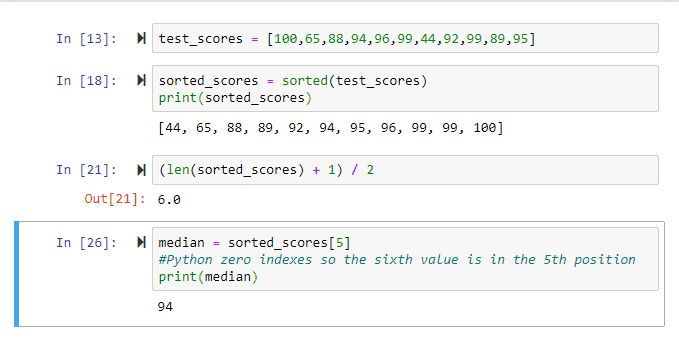
  • Step 1: Create a variable named test_scores and populate it with a list of individual test scores. This establishes your raw dataset for analysis.

  • Step 2: Create a variable named sorted_scores and set it equal to sorted(test_scores). The sorted() function arranges your test scores in ascending order, which is essential for accurate median calculation.

  • Step 3: Apply the len() function to sorted_scores to determine the number of values in your list, then implement our median position formula: (len(sorted_scores) + 1) / 2. This calculation identifies the median's position within your ordered dataset.

  • Step 4: Use the result from Step 3 as an index for your sorted_scores list. Remember that Python uses zero-based indexing, so subtract 1 from your position result. For example, if your calculation yields position 6, access sorted_scores[5] to retrieve the 6th element. Assign this value to a median variable and display the result using print().

Python Median

Python Median Calculation Process

1

Create Test Data

Create a variable named test_scores and populate it with a list of individual test scores for your dataset.

2

Sort the Dataset

Create sorted_scores variable using sorted(test_scores) function to arrange values from smallest to largest.

3

Calculate Position

Use len() on sorted_scores, add 1, and divide by 2 to find the median position using the standard formula.

4

Extract Median Value

Use the calculated position with zero-based indexing (position-1) to get sorted_scores[index] and assign to median variable.

Zero Indexing Reminder

Python uses zero-based indexing, so the sixth position in your ordered list is actually index [5]. Always subtract 1 from your calculated position.

Median Calculation Checklist

0/5

Key Takeaways

1Median represents the middle value in an ordered dataset and is more resistant to outliers than the mean
2Manual median calculation requires ordering data and using the formula (n+1)/2 to find the middle position
3For datasets with even numbers of values, average the two middle numbers to calculate the median
4Median is particularly useful for income data, house prices, and other skewed distributions where outliers exist
5Python's built-in sorted() and len() functions enable efficient median calculation without external libraries
6Zero-based indexing in Python requires subtracting 1 from the calculated position to access the correct array element
7Understanding the mathematical foundation helps validate and debug Python median calculations
8The median better represents overall data trends when extreme values would skew the mean significantly

RELATED ARTICLES