Finding the Mean Using Python
Mean (Average) in Python
Definition
Sum of all values divided by the count — the most common 'average'.
When to Use It
Quick summary of normal-ish data. Investment fund's average performance across holdings.
Outlier Sensitivity
One huge value skews the mean dramatically — median or trimmed mean are alternatives.
Python Code
import statistics; statistics.mean([1,2,3,4,5]) returns 3.0. NumPy: np.mean(arr).
Noble Desktop's Python Programming Immersive covers AI APIs, data analysis, and modern Python development.
In this series of posts, we'll cover various applications of statistics in Python. This first post talks about calculating the mean using Python.
Finding the Mean: Tutorial
So how do we find the mean? The mean is a relatively easy measure to find mathematically, it takes only two steps. To calculate the mean, you must add up all the numbers and then divide the sum of those numbers by how many data points they are, or in math terms, it is simply the sum divided by the count (remember these two terms). It is good to know the math and understand where the number is coming from but Python does all of this for us with two short commands. Look below on how easy it is to solve for the mean in Python.
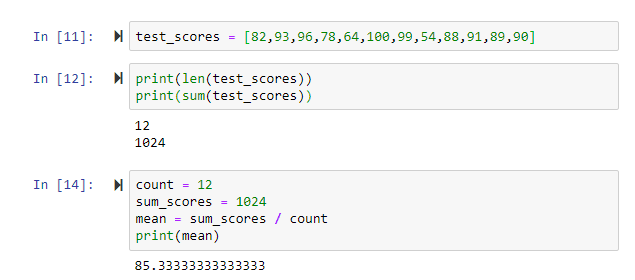
Step 1: Create a variable named test_scores and populate it with a list of individual test scores.
Step 2: Use the lenattribute to count how many data points are in test_scores and use the sum attribute to add up all the scores in test_scores.
Step 3: Create a variable named count and set it equal to 12 (got 12 from the len function) and create a variable named sum scores and set it equal to 1024 (got 1024 from the sum function).
Step 4: Divide the sum by the count which is how you find the mean and then use the print function to show the output to the user.
Note: If you are new to Python or need to brush up on some skills check out our Python Classes that are offered in-person or live online.