April 1, 2026Jerron Smith/6 min read

Music Video: Adjustment Layers & Color Correcting Videos in Premiere Pro

Master professional video color correction in Premiere Pro

Key Concepts in Video Color Correction

Color Correction

Fixing color problems and achieving natural, accurate colors in your footage. This involves adjusting white balance, exposure, and basic color parameters.

Adjustment Layers

Non-destructive editing layers that apply effects to all clips below them on the timeline. Perfect for global color adjustments across multiple clips.

Color Grading

Creative color styling to achieve a specific look and mood. This goes beyond correction to create artistic visual styles and enhance storytelling.

Topics Covered in This Premiere Pro Tutorial:

Color Correction, Adjustment Layers, Using Adjustment Layer Clips

Exercise Preview

preview color correction

Project Requirements

This tutorial uses a pre-edited music video project with multi-cam footage and b-roll already assembled. You'll be adding color correction and grading as the final enhancement steps.

Exercise Overview

Professional video production rarely delivers perfect footage straight from camera. Whether you're correcting exposure inconsistencies, white balance issues from mixed lighting conditions, or creating a specific aesthetic to match your creative vision, color correction and grading are essential skills that separate amateur content from polished, professional work. This exercise will teach you to use adjustment layers—a non-destructive workflow that preserves your original footage while giving you maximum flexibility to refine your color decisions throughout the editing process.

Getting Started

  1. If you have a project open in Premiere, choose File > Close All Projects.

  2. Let's start with a project file that has our multi-cam edits and b-roll editing all done. Choose File > Open Project or hit Cmd–O (Mac) or CTRL–O (Windows).

  3. Navigate to Desktop > Class Files > Premiere Pro Intermediate > Multicam—Music Video > Finished Projects.

  4. Double–click on Before You Accuse Me—Color Correcting.prproj to open it.

    NOTE: If you see a dialog about Converting Project (from a prior version) refer to Fixing Version Compatibility Issues section in Exercise 1A. If the Link Media dialog opens refer to Locating Missing Media in Exercise 1A.

  5. Go to File > Save As and:

    • Name the file Before You Accuse Me—Your Name.prproj
    • Save it to Desktop > Class Files > Premiere Pro Intermediate > Multicam—Music Video (replacing any existing file).

Now that your project is properly organized and saved, you'll implement a professional color correction workflow using adjustment layers. This method allows you to apply color changes to multiple clips simultaneously while maintaining the ability to fine-tune individual adjustments later.

Project Setup Workflow

1

Close Current Projects

Use File > Close All Projects to ensure a clean workspace before opening the exercise files

2

Open Exercise Project

Navigate to the Finished Projects folder and open Before You Accuse Me—Color Correcting.prproj

3

Save Your Version

Use File > Save As to create your own working copy with your name in the filename

Common Setup Issues

If you encounter version compatibility or missing media dialogs, refer to the troubleshooting sections in Exercise 1A for step-by-step solutions.

Color Correcting with an Adjustment Layer

Adjustment layers are the industry standard for non-destructive color correction. They function like transparent overlays that affect all video tracks beneath them, allowing you to make broad corrections across your entire timeline without permanently altering your source footage. This approach is particularly valuable when working with multi-camera shoots where consistent color matching is essential.

  1. Choose Window > Workspaces > Editing.
  2. Choose Window > Workspaces > Reset to Saved Layout.
  3. Hit the \ (backslash) key to zoom out to see everything in the Timeline.
  4. On the left side of the Timeline, CTRL–click (Mac) or Right–click (Windows) on the Video 1 track name and choose Add Track.

    This creates a new video layer above your existing footage where the adjustment layer will reside. Keeping adjustment layers on separate tracks maintains a clean, organized timeline structure.

  5. Hold Shift and hit the + (plus) key to expand the height of all tracks on the Timeline.

  6. In the Project panel, click on any empty area to deselect any active files or bins.

  7. At the bottom right of the Project panel, click on the New Item button_newItem button and choose Adjustment Layer.

    • The default settings match your sequence settings automatically, so click OK.
  8. Drag the new Adjustment Layer clip to the beginning of the Video 2 track on Timeline.

  9. Choose the Selection tool tool_selection.
  10. Drag the end of the Adjustment Layer clip until it matches the length of the video on the Video 1 track.

  11. Choose Window > Workspaces > Color.
  12. Choose Window > Workspaces > Reset to Saved Layout.

  13. If necessary, click on the Adjustment Layer clip on the Timeline to select it.

  14. Move the Timeline playhead to 4:15 so you can see a clip of the main performer.

  15. In the Lumetri Color panel on the right, if the Basic Correction is closed, click on it to expand it.

  16. Under White Balance, drag the Temperature slider to the left until it reads -75.

    This removes the warm orange color cast typical of tungsten lighting, creating more natural-looking skin tones. Temperature adjustments are often your first step in color correction, as they establish the foundational white balance for your footage.

  17. Under Tone, change Highlights to 40.

    This recovers detail in the brighter areas without creating harsh clipping, maintaining the natural contrast while improving visibility.

  18. Also in the Tone section, change Shadows to 20.

    This lifts the darker regions to reveal more detail while preserving the overall mood. Be careful not to over-lift shadows, as this can create a flat, washed-out appearance.

  19. Preview the Timeline to see that these color adjustments affect any video that is located below the Adjustment Layer.

  20. In the Timeline, CTRL–click (Mac) or Right–click (Windows) on the Adjustment Layer clip and choose Rename.

  21. Rename it to Main Color Correction and click OK.

  22. Choose File > Save or hit Cmd–S (Mac) or CTRL–S (Windows).

With your primary color correction complete, you've established a solid foundation with proper white balance and exposure. The next step involves creative color grading to enhance the visual mood and aesthetic of your project.

Creating and Applying Adjustment Layers

1

Add Video Track

Right-click on Video 1 track name and choose Add Track to create space for the adjustment layer above your footage

2

Create Adjustment Layer

Click the New Item button in Project panel and select Adjustment Layer with default settings

3

Position and Size

Drag the adjustment layer to Video 2 track and extend its duration to match your footage length

4

Apply Color Corrections

Switch to Color workspace and use Lumetri Color panel to make Temperature, Highlights, and Shadows adjustments

Color Correction Values Applied

Temperature
75
Highlights
40
Shadows
20
White Balance Correction

Moving Temperature to -75 removes the orange tint present in the music video footage, creating more natural skin tones and overall color balance.

Adding a Color Grade with a Look

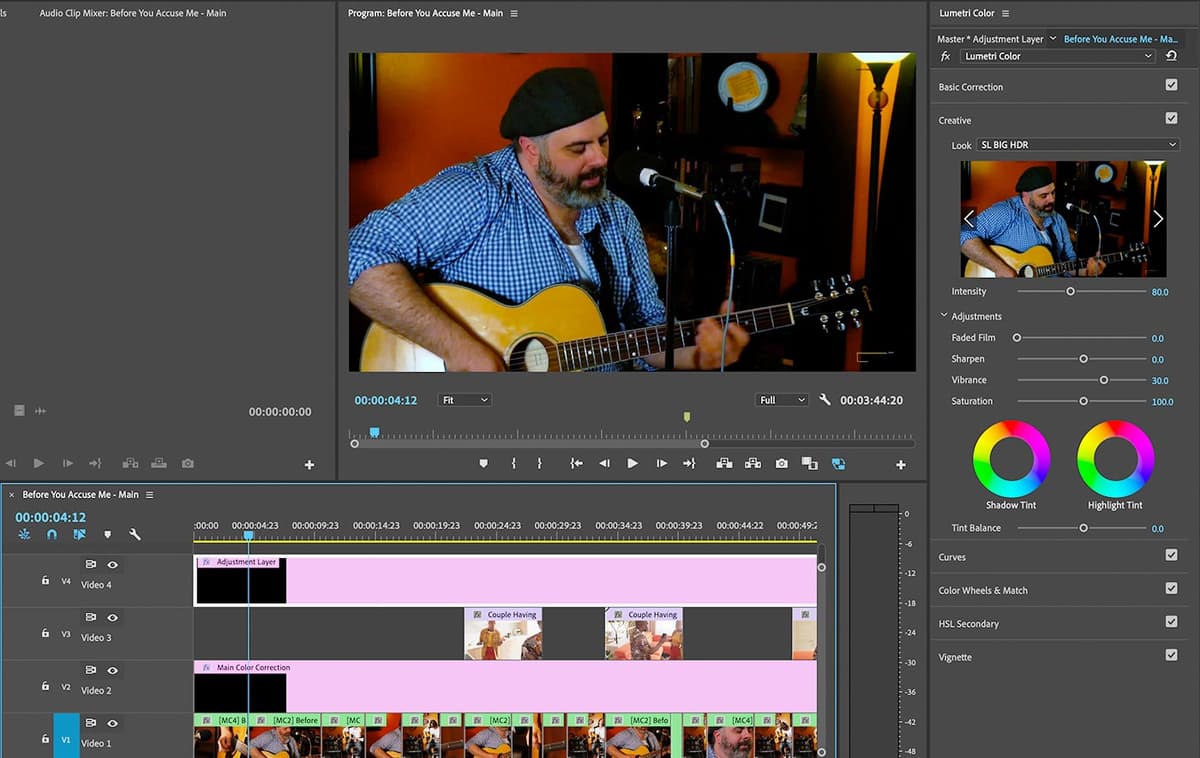
Color grading goes beyond correction—it's about creating atmosphere and emotion through deliberate color choices. Modern audiences expect sophisticated color treatment that supports the narrative. By layering a second adjustment layer, you maintain the flexibility to adjust your creative grade independently from your technical corrections, a workflow standard in professional post-production facilities.

  1. In the Timeline panel, there's a divider between the Video and Audio tracks. Drag that divider down until you can see the Video 4 track.

  2. Drag a second copy of the Adjustment Layer clip from the Project panel to the beginning of the Video 4 track on the Timeline.

  3. Extend the duration of the new Adjustment Layer clip with the selection tool so that it matches the length of the clips on Video 1 and Video 2.

  4. CTRL–click (Mac) or Right–click (Windows) on the Adjustment Layer on Video 4 and choose Rename.

  5. Rename it to Color Grade and click OK.

  6. In the Lumetri Color panel, click on the Creative section to expand it.

  7. From the Look menu choose SL BIG HDR.

  8. Change Intensity to 80

  9. Change Vibrance to 30.

    Vibrance intelligently enhances color saturation by targeting mid-tone colors while protecting skin tones from becoming oversaturated. This creates a more natural enhancement compared to traditional saturation controls, which affect all colors equally.

  10. Choose File > Save or hit Cmd–S (Mac) or CTRL–S (Windows).

    Keep the project open because you'll use it in the next exercise.

Color Correction vs Color Grading

FeatureColor CorrectionColor Grading
PurposeFix color problemsCreate artistic style
Layer UsedVideo 2 - Main Color CorrectionVideo 4 - Color Grade
Lumetri PanelBasic Correction sectionCreative section
AdjustmentsTemperature, Highlights, ShadowsLook, Intensity, Vibrance
Recommended: Apply correction first on lower track, then creative grading on higher track for non-destructive workflow

Color Grade Settings Applied

Look Intensity38%
Vibrance14%
Base Level48%
Professional Tip

Using separate adjustment layers for correction and grading allows independent control over each process and maintains flexibility for future revisions.

Key Takeaways

1Use adjustment layers for non-destructive color correction that affects all clips below them on the timeline
2Separate color correction from color grading by using multiple adjustment layers on different video tracks
3Start color work by correcting white balance issues before applying creative looks and styles
4The Lumetri Color panel provides both Basic Correction tools for fixing problems and Creative tools for stylistic enhancement
5Temperature adjustments can remove color casts - negative values cool the image while positive values warm it
6Highlights and Shadows adjustments in the Tone section help balance exposure across different brightness ranges
7Creative looks like SL BIG HDR can dramatically change the mood and style of your footage when applied thoughtfully
8Vibrance provides more natural color enhancement compared to saturation by protecting skin tones and avoiding oversaturation

RELATED ARTICLES