April 1, 2026Dan Rodney/4 min read

Using the Spot Removal Tool

Master Advanced Photo Editing with Lightroom Tools

What You'll Learn

Spot Removal Mastery

Learn to seamlessly remove large, complex shapes from your images using Lightroom's powerful Spot Removal tool. Master the techniques for selecting and replacing unwanted elements.

Source Area Control

Understand how to fine-tune Lightroom's automatic sampling by manually adjusting source areas for more realistic replacements.

Topics Covered in This Lightroom Tutorial:

Removing One Kayak from the Photo, Changing the Source Area

Exercise Preview

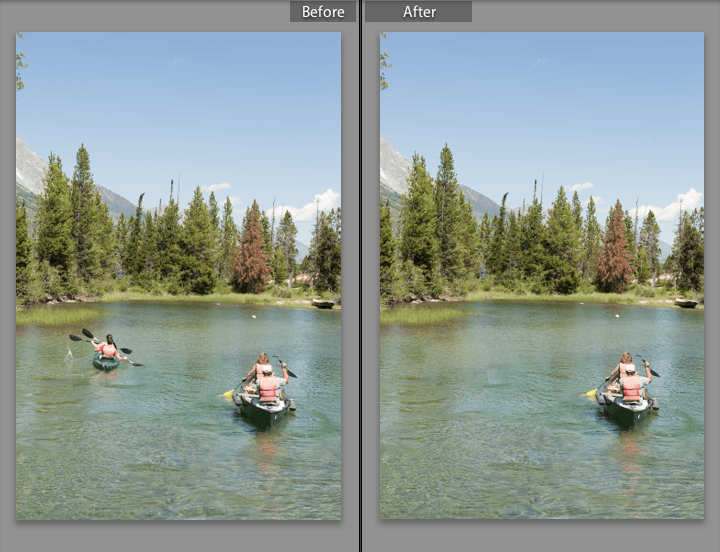
lightroom preview4E

Exercise Overview

In this exercise, you'll master the Spot Removal tool to seamlessly eliminate complex shapes from your images—a technique that's become increasingly essential in professional workflows. Whether you're removing unwanted tourists from architectural shots or cleaning up distracting elements in commercial photography, this tool delivers results that once required extensive Photoshop work.

Tutorial Focus

This exercise demonstrates removing a large, complex shape - specifically kayakers with their paddles, splash, wake, and reflections - showcasing the Spot Removal tool's capabilities beyond simple blemish removal.

Removing One Kayak from the Photo

We'll continue working with the images you imported in the first exercise, applying professional-grade object removal techniques that can save hours in post-production workflows.

  1. In the Library module, select the kayaks photo (20110822_YourName_022).

  2. Press the D key to switch to the Develop module.

  3. Below the Histogram panel on the right, click the Spot Removal tool spot removal tool.

  4. At the top of the Navigator panel, click on 1:1 to view the image at 100% magnification. This pixel-level view is crucial for precision work. Move the preview box over the image until you can clearly see the leftmost kayak.

  5. Press the right bracket key ] several times to increase the brush size. We recommend sizing the brush to approximately match the width of the kayakers' paddle blades—this provides optimal coverage without unnecessarily large selections that could complicate the healing process.

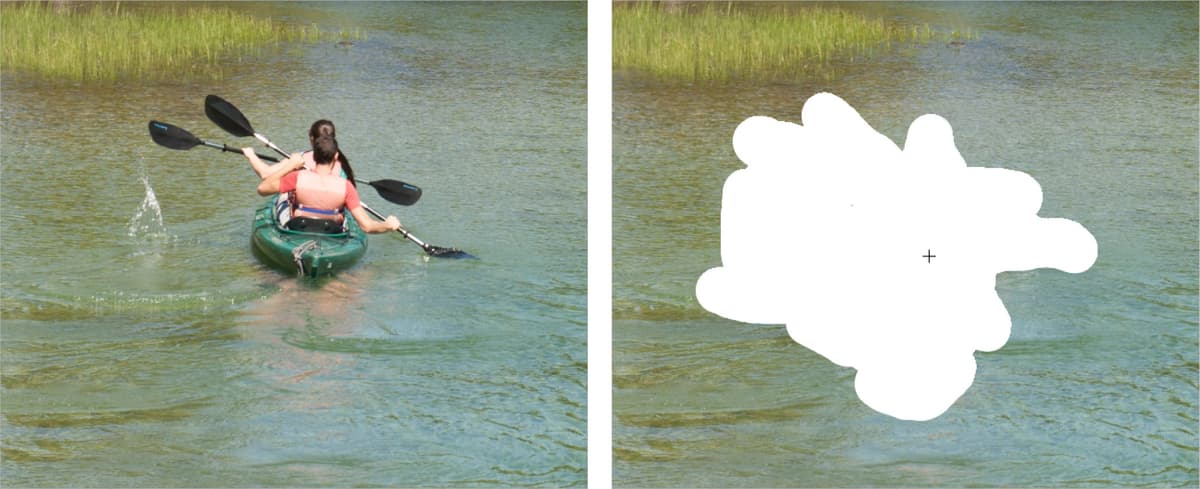
  6. Click and drag to paint comprehensively over the kayakers, their splash patterns, the wake disturbance, and the kayakers' reflection in the water (as demonstrated in the left screenshot below). Don't obsess over precision during this initial selection phase; while you're actively painting, the selected area appears as an irregular white overlay (shown in the right-hand image). Focus on complete coverage rather than clean edges:

    adv healing brush paint over kayak

  7. When you release the mouse, Lightroom automatically analyzes the surrounding area and samples a water section that it calculates will provide the most seamless replacement. The AI-driven content-aware technology has improved significantly since Lightroom's early versions, making this automatic selection remarkably accurate in most scenarios.

  8. Press the Z key to zoom out and assess the full effect. Notice how Lightroom displays the outline of the source area it has chosen to replace the leftmost kayak—this visual feedback helps you understand the tool's decision-making process.

  9. Click the Spot Removal tool spot removal tool again to deactivate it and hide the selection borders, allowing you to evaluate the result without visual distractions.

Spot Removal Process

1

Setup and Navigation

Select the kayaks photo in Library module, press D key for Develop module, click Spot Removal tool, and set view to 1:1 for 100% zoom

2

Brush Size Adjustment

Position over leftmost kayak, press right bracket key to increase brush size to match the width of the kayakers' paddles

3

Selection Process

Click and drag to paint over kayakers, splash, wake, and reflection - don't worry about precision as it appears as a white blob while selecting

4

Automatic Processing

Release mouse to let Lightroom automatically sample a matching water portion, then press Z to zoom out and view the result

Brush Sizing Tip

Use the right bracket key to increase brush size to approximately match the width of the black part of the kayakers' paddles for optimal coverage.

Changing the Source Area

While Lightroom's automatic source selection is sophisticated, professional results often require manual refinement. Here's how to fine-tune the replacement for optimal results:

  1. Even with Lightroom's advanced algorithms, manual adjustment often yields superior results, particularly when working with complex textures like moving water or when the automatic selection includes unwanted elements.

  2. Click the Spot Removal tool spot removal tool again to reactivate it and display the selection overlays.

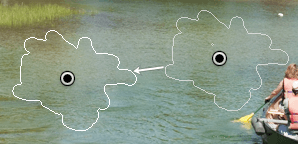
  3. Activate the target area (where the kayakers were removed) by clicking its circle gray circle. When activated, a black dot appears inside the circle black dot circle, and a corresponding black dot marks the source area that Lightroom is sampling from.

  4. Click on the source area's circle black dot circle and drag it to a more suitable location—in this case, closer to the shoreline where the water characteristics better match the original kayak area. As you drag, Lightroom provides real-time preview feedback, allowing you to see exactly how different source areas will affect the final result. Take time to experiment with multiple positions; the difference between good and exceptional results often lies in this fine-tuning phase. Our optimal choice is shown below:

    advanced healing brush screenshot2

  5. Examine the final result critically. While the replacement may not achieve the pixel-perfect invisibility possible with extensive Photoshop work using multiple layers, masks, and clone stamping, Lightroom's Spot Removal tool delivers remarkably professional results for rapid workflow integration.

    Water presents one of the most challenging scenarios for any cloning or healing tool due to its complex interplay of reflections, ripples, and light patterns. The fact that Lightroom's Spot Removal tool handles this complexity so effectively makes it invaluable for photographers working with tight deadlines. For materials with uniform textures or regular patterns—such as skies, walls, or fabrics—this tool produces even more seamless results, making it an indispensable component of any professional retoucher's arsenal.

Fine-tuning Source Selection

1

Reactivate Tool

Click the Spot Removal tool again to select it and reveal the sampling areas for adjustment

2

Select Target Area

Click the circle where the kayakers used to be - a black dot appears inside to show it's activated

3

Adjust Source Location

Click and drag the source area's circle to a better location, using the live preview to find the most seamless replacement

Lightroom vs Photoshop for Complex Removal

Pros
Quick and efficient for immediate results
Handles water and regular patterns well
Non-destructive editing workflow
Integrated with photo management
Good for smooth and patterned areas
Cons
May not achieve perfect results for complex scenes
Less precise control than dedicated tools
Limited compared to Photoshop for masterful disguising
Tool Versatility

Water is one of the most difficult materials to clone or replace in photography, yet Lightroom's Spot Removal tool handles it remarkably well. It performs even better with smooth areas or regular patterns.

Key Takeaways

1The Spot Removal tool can handle complex shape removal beyond simple spot corrections, including kayakers with reflections and wake patterns
2Brush size should be adjusted to match the scale of elements being removed - use the right bracket key for quick size increases
3Precision isn't critical during the initial selection phase as the white blob appearance is temporary until processing
4Lightroom automatically samples replacement areas but manual source area adjustment provides better control over final results
5Live preview functionality allows real-time assessment when dragging source areas to new locations
6Water presents unique challenges for cloning but Lightroom's tool handles it effectively for quick fixes
7The tool performs best on smooth areas and regular patterns compared to highly complex or irregular textures
8While not achieving Photoshop-level perfection, the Spot Removal tool offers powerful capabilities for efficient photo cleanup within Lightroom's workflow

RELATED ARTICLES