Mergers and Acquisitions Model Overview
M&A Model Build
Sources & Uses
Purchase price funded by cash, debt, and acquirer stock.
Combined Income Statement
Pro forma after acquisition with synergies and amortization.
Accretion / Dilution Analysis
Combined EPS vs acquirer's standalone EPS.
Sensitivity
Test impact of synergy assumptions and purchase price.
Noble Desktop's Financial Analyst Training Program covers financial modeling, valuation, accounting, and Excel for finance.
Learn the step-by-step process of building a mergers and acquisitions model in Excel and conducting an accretion/dilution analysis, using Google and Motorola as a case study.
Mergers and acquisitions (M&A) is a general term that describes the consolidation of companies or assets through various types of financial transactions.
You can find separate videos on M&A theory and accounting. In this video, we will actually build an M&A Model in Excel and perform accretion/dilution analysis for that.
We have acquired Google and target company Motorola. We’ll perform the model in 4 steps.
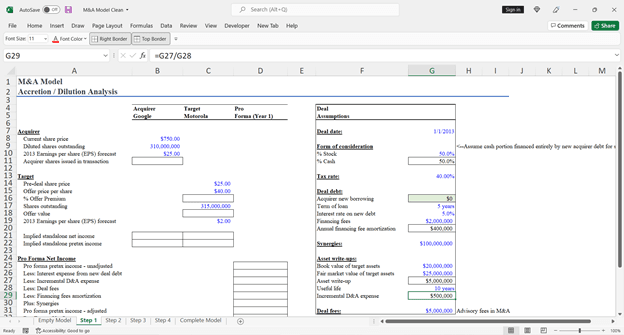
Step 1: Deal Assumptions
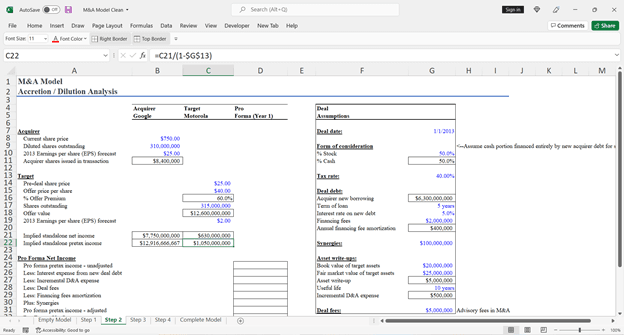
Step 2: Acquirer shares issued, Target offer value and standalone pretax net income for both
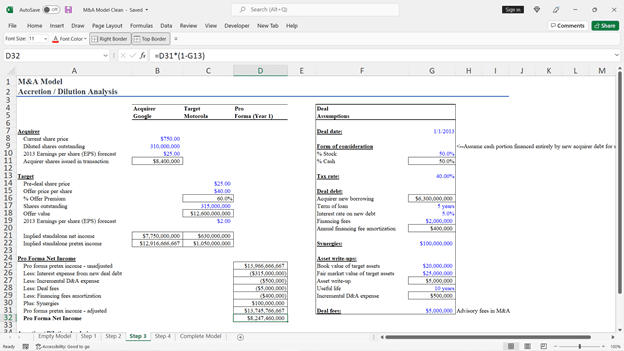
Step 3: Pro Forma Net Income
Pro Forma earnings describe a financial statement that has hypothetical amounts (estimates) built into the data to give a picture of a company’s profit if certain nonrecurring items were excluded. Pro forma earnings usually leave out one-time expenses that are not a part of normal company operations such as restructuring costs following a merger.
Step 4: Accretion / Dilution Analysis
An accretion/dilution analysis is a simple test used to evaluate the merit of a proposed merger or acquisition deal. The accretion/dilution analysis determines if the post-transaction earnings per share (EPS) are increased or decreased.
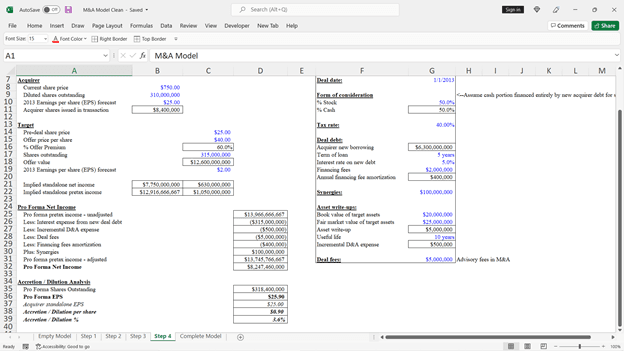
If we see accretion, it’s a good sign and the M&A transaction seems to make sense. However, you need to take into consideration not only quantitative analysis when analyzing an M&A deal but a qualitative as well to make sure that strategically the M&A transaction makes sense for both acquirer and target.