April 1, 2026/2 min read

Trading Comps - Model 1

Professional Financial Analysis Through Comparable Company Valuation

Comparable Companies Analysis Overview

Coca-Cola

Leading global beverage company serving as primary comparable for valuation analysis. Established market position with consistent financial metrics.

Monster Beverage Corporation

Energy drink specialist providing growth-oriented comparable metrics. Higher growth profile compared to traditional beverage companies.

PepsiCo

Diversified food and beverage conglomerate offering comprehensive market comparison. Balanced portfolio across multiple consumer segments.

Key Valuation Metrics Calculated

$204B
Minimum Implied EV
$307B
Maximum Implied EV
3
Comparable Companies

Trading Comps Methodology

1

Select Comparable Companies

Identify three comparable companies: Coca-Cola, Monster Beverage Corporation, and PepsiCo based on industry and business model similarities.

2

Calculate Base Metrics

Compute share price, market cap (equity value), and enterprise value for each comparable company to establish valuation foundation.

3

Determine Value Drivers

Calculate key financial metrics including Sales, EBITDA, EBIT, and EPS for comprehensive multiple analysis.

4

Compute Trading Multiples

Apply formulas to calculate relevant multiples using enterprise value and equity value against operational metrics.

Multiple Calculation Framework

The model uses specific Excel formulas: E13==$D6/E6, I13=$D6/I6, M13=$D6/M6, Q13=$B6/Q6 to systematically calculate trading multiples across all comparable companies.

Coca-Cola is just along the lines with its peer group
This assessment indicates that Coca-Cola's valuation multiples align closely with industry standards, suggesting fair market valuation relative to comparable companies.

Statistical Analysis Process

1

Extract Maximum Multiple

Use MAX function (E20=MAX(E14:E17)) to identify the highest multiple within the comparable set for upper bound analysis.

2

Identify Minimum Multiple

Apply MIN function (E21=MIN(E14:E17)) to determine the lowest multiple for establishing the valuation floor.

3

Calculate Mean Multiple

Compute average using AVERAGE function (E22=AVERAGE(E14:E17)) to establish central tendency for fair value estimation.

4

Reference Target Company

Isolate target company multiple (E23=E14) for direct comparison against peer group statistics.

Implied Enterprise Value Range Analysis

Minimum EV
204
Maximum EV
307
Range Spread
103
Valuation Range Established

The analysis produces an implied enterprise value range from $204B to $307B, providing a comprehensive valuation band for investment decision-making based on peer group multiples.

For this comparable company analysis, we've selected three industry leaders in the beverage sector: Coca-Cola, Monster Beverage Corporation, and PepsiCo. These companies represent different segments within the industry while maintaining sufficient operational similarities to serve as meaningful benchmarks.

Our initial calculations establish the fundamental valuation metrics for each company, including current share price, market capitalization (equity value), and enterprise value. These baseline figures form the foundation for all subsequent multiple calculations and provide essential context for relative valuation assessment.

The analysis incorporates key operational and financial value drivers that institutional investors and analysts rely upon: Sales (revenue), EBITDA (earnings before interest, taxes, depreciation, and amortization), EBIT (earnings before interest and taxes), and EPS (earnings per share). These metrics capture different aspects of company performance, from top-line growth to operational efficiency and bottom-line profitability.

With our data framework established, we proceed to calculate the core valuation multiples that drive investment decisions:

E13==$D6/E6

I13=$D6/I6

M13=$D6/M6

Q13=$B6/Q6

Our preliminary analysis reveals that Coca-Cola's valuation metrics align closely with its peer group, suggesting the market is pricing the company fairly relative to comparable businesses. This alignment provides confidence in our comparative approach and indicates that extreme valuation discrepancies are unlikely to distort our analysis.

To extract actionable insights from our multiple calculations, we employ a statistical approach that captures the full range of peer valuations. By isolating the highest and lowest multiples alongside the group mean, we can establish a comprehensive valuation range for our target company:

E20=MAX(E14:E17)

E21=MIN(E14:E17)

E22=AVERAGE(E14:E17)

E23=E14

Applying this methodology to Coca-Cola's operational metrics, we begin with the company's fundamental EBITDA performance:

EBITDA of Coca-Cola: F26=H6

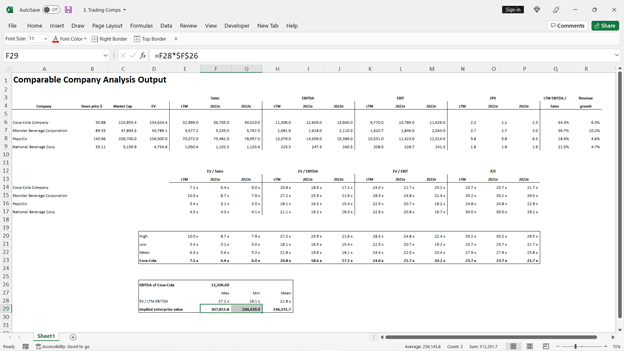
The EV/LTM EBITDA multiple analysis produces our core valuation framework: Max=F28=H20; Min=G28=H21; Mean=H28=H22. These multiples, derived from peer company trading patterns, establish the parameters for Coca-Cola's implied enterprise value calculation.

Implied EV = f29=F28*$F$26

Our comprehensive analysis yields an implied enterprise value range of $204 billion to $307 billion for Coca-Cola. This $103 billion spread reflects the natural variation in market valuations across comparable companies and provides investors with both conservative and optimistic scenarios for the company's intrinsic value. The wide range underscores the importance of considering multiple valuation approaches and market conditions when making investment decisions.

Screenshot of an Excel workbook titled 'Comparable Company Analysis Output' displaying financial metrics, multiples, and valuation figures for various companies in a tabular format.

Key Takeaways

1Three comparable companies (Coca-Cola, Monster Beverage Corporation, PepsiCo) provide comprehensive peer group analysis for trading multiples valuation
2Key financial metrics including share price, market cap, enterprise value, Sales, EBITDA, EBIT, and EPS form the foundation for multiple calculations
3Systematic Excel formulas enable consistent calculation of trading multiples across all comparable companies for standardized analysis
4Coca-Cola's valuation multiples align closely with peer group averages, indicating fair market valuation relative to industry standards
5Statistical analysis using MAX, MIN, and AVERAGE functions provides comprehensive multiple ranges for upper bound, lower bound, and central tendency
6The implied enterprise value range of $204B to $307B offers a $103B valuation band based on peer group EBITDA multiples
7Trading comps methodology provides market-based valuation approach using actual trading multiples from comparable public companies
8The model structure allows for systematic comparison between target company metrics and peer group statistical measures

RELATED ARTICLES