March 23, 2026/5 min read

How to Write Effective Google Ads

Master Google Ads copy that converts users effectively

Core Components of Google Ads Success

Keywords

The foundation of targeting and relevance. Choose keywords that match user intent and business goals.

Ad Copy

The message that convinces users to click. Must balance user appeal with search engine optimization.

Landing Pages

The destination experience that converts clicks into customers. Must align with ad promises.

Google Ads Best Practices Ad Copy

Creating a successful Google Ads campaign requires orchestrating multiple elements—keyword selection, landing page optimization, and compelling ad copy. While each component matters, your ad copy serves as the crucial first impression that determines whether prospects click through or scroll past. This article breaks down the strategic approach to crafting ad copy that drives results.

The User & the Engine

Effective Google Ads copywriting requires balancing two masters: your human audience and Google's algorithm. While these interests often align, understanding their distinct requirements is essential for maximizing performance.

Google evaluates your ads through Quality Score, which comprises three core components: ad relevance, expected click-through rate (CTR), and landing page experience. The distinction between ad relevance and expected CTR illustrates the dual nature of optimization—one focuses on algorithmic matching, while the other measures human appeal. Mastering both ensures your ads not only qualify for competitive auctions but also compel users to take action.

User Optimization vs Engine Optimization

FeatureUser FocusEngine Focus
Primary GoalDrive clicks and engagementAchieve keyword relevance
Success MetricExpected CTRAd Relevance Score
Copy StrategyCompelling and persuasiveKeyword matching
Recommended: Balance both approaches for optimal quality score and performance

Ad Relevance

Ad relevance measures the semantic connection between your target keywords and ad content. Google's sophisticated natural language processing evaluates how closely your messaging aligns with search intent. For instance, if you're bidding on "excel corporate training," your ad copy should naturally incorporate these terms without keyword stuffing.

This relevance scoring directly impacts your ad rank and cost-per-click. Ads with strong keyword alignment typically achieve better Quality Scores, leading to lower costs and higher ad positions—a competitive advantage that compounds over time.

Quality Score Components

Quality score consists of three key elements: ad relevance, expected CTR, and landing page experience. Ad relevance specifically measures keyword-to-ad alignment.

If your keyword is excel corporate training then you'll want to include those terms within your ad once or twice
Demonstrates the direct relationship between keyword targeting and ad copy content for maximum relevance scoring

Expected CTR

Expected CTR represents Google's prediction of how often users will click your ad based on historical performance data and contextual factors. Unlike ad relevance, this metric depends entirely on human behavior and emotional response to your messaging.

Consider the difference between a technically relevant but uninspiring headline like "Excel Corporate Training | Excel Training for Business" versus a compelling alternative such as "Transform Your Team's Excel Skills | Corporate Training That Delivers Results." Both may score well on relevance, but the latter creates urgency and communicates tangible outcomes that drive clicks.

High Relevance vs High CTR Ad Copy

Pros
Keyword-heavy copy improves ad relevance scores
Better quality score can reduce cost per click
Higher search engine ranking potential
Cons
May lack compelling user appeal
Could result in lower actual click-through rates
Misses opportunity for persuasive messaging

Best Practices for Great Ad Copy

With the foundational concepts established, let's examine the tactical approaches that consistently produce high-performing ad copy. These practices have proven effective across industries and continue to drive results in today's competitive landscape.

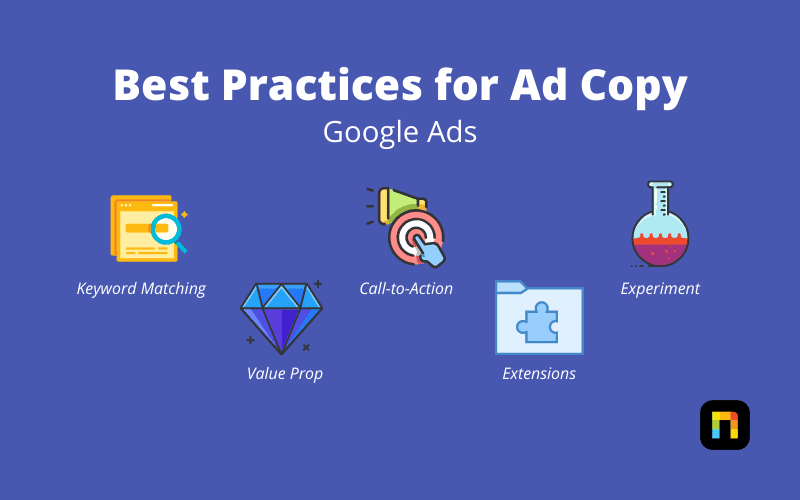
1. Keyword Matching

Strategic keyword integration remains the foundation of ad relevance, though the approach has evolved significantly. Rather than mechanical keyword insertion, focus on natural language patterns that incorporate your target terms organically. Modern searchers expect conversational, contextually appropriate messaging that addresses their specific needs.

Include your primary keyword once in the headline and once in the description, but prioritize readability over keyword density. Google's advanced algorithms now recognize semantic variations and related terms, so exact-match repetition is less critical than comprehensive topic coverage.

2. Clear Value Prop

Your value proposition must immediately differentiate your offering in a crowded marketplace. Today's consumers are increasingly sophisticated and skeptical—generic promises won't suffice. Instead, lead with specific, quantifiable benefits that address pain points your competitors ignore.

Effective value propositions often combine emotional appeals with rational justification. For example, "Master Excel in Half the Time—Our Proven Method Gets Results 3x Faster" addresses both the emotional desire for efficiency and provides a concrete performance metric. Consider highlighting unique advantages such as proprietary methodologies, exclusive partnerships, or measurable outcomes that competitors cannot replicate.

3. Call-to-Action

Strategic calls-to-action guide prospects through your conversion funnel while creating psychological urgency. The most effective CTAs match the user's position in the buying journey—awareness-stage searchers respond to "Learn More" or "Discover How," while decision-ready prospects prefer "Get Started" or "Book Now."

Action-oriented language creates momentum and reduces decision paralysis. Experiment with time-sensitive elements like "Start Today," urgency indicators such as "Limited Spots Available," or benefit-focused phrases like "Unlock Your Potential." Test different CTA styles to identify what resonates with your specific audience segments.

4. Ad Extensions

Ad extensions represent valuable real estate that expands your messaging footprint while providing additional conversion pathways. These elements can increase your ad's visibility by up to 15% and often improve click-through rates significantly.

Sitelink extensions enable sophisticated audience segmentation by directing different user types to tailored landing pages. For "excel classes" campaigns, strategic sitelinks might include "Beginner Courses," "Advanced Certification," "Corporate Packages," and "Online Learning." This self-selection mechanism improves user experience while increasing conversion likelihood by matching intent with appropriate content.

Callout extensions highlight competitive advantages and unique selling points that might not fit naturally in your main ad copy. Examples include "Industry-Certified Instructors," "30-Day Money-Back Guarantee," "Fortune 500 Client Base," or "24/7 Support Included." These elements build credibility and address common objections before they arise.

5. Experiment

Systematic testing transforms good campaigns into exceptional ones. The digital environment provides unprecedented opportunities for real-time optimization, but success requires structured experimentation rather than random changes.

Implement a robust testing framework with 3-4 ad variations per ad group, each testing a single variable—headline approach, value proposition emphasis, or CTA style. Google's ad rotation optimization automatically surfaces top performers, but supplement this with manual analysis to understand why certain messages resonate.

Modern testing should extend beyond simple CTR optimization to include conversion quality metrics. An ad with lower CTR but higher conversion rates and customer lifetime value often delivers superior ROI. Track performance across the entire funnel to optimize for business outcomes rather than vanity metrics.

Essential Ad Copy Framework

1

Keyword Matching

Include target keywords once or twice in your ad copy to improve ad relevance and quality score. This is the easiest and most impactful optimization.

2

Clear Value Proposition

Communicate what makes your offering unique and compelling. Highlight special offers or differentiators that set you apart from competitors.

3

Strong Call-to-Action

Direct users toward specific actions whether signing up, purchasing, or engaging. Clear CTAs improve conversion rates and user experience.

4

Leverage Ad Extensions

Use sitelinks, callouts, and other extensions as free additional real estate to provide more information and increase ad visibility.

5

Continuous Testing

Run multiple ad variations simultaneously and use ad rotation optimization to identify top performers and continuously improve results.

Ad Extension Types and Benefits

Sitelink Extensions

Enable customer self-selection into relevant landing pages. Example: Beginner classes, Advanced classes, Corporate training.

Callout Extensions

Highlight additional perks and benefits like free shipping, great service, or affordable pricing to strengthen your offer.

Testing Best Practice

Run 3-4 ads per ad group with ad rotation optimization enabled. Regularly replace poorest performers with new variations to continuously improve performance over time.

Recap

Implementing these ad copy best practices positions your Google Ads campaigns for sustained success. While ad copy represents just one element of campaign performance, it serves as the critical first touchpoint that shapes prospect perception and drives initial engagement.

Remember that great ad copy balances algorithmic requirements with human psychology, delivers clear value propositions that differentiate your offering, and guides prospects toward meaningful action. As search behavior and platform capabilities continue evolving, maintain a testing mindset that adapts these principles to your unique market conditions and audience preferences.

Pre-Launch Ad Copy Checklist

0/6

Key Takeaways

1Google Ads success requires balancing optimization for both users and search engines through ad relevance and expected CTR
2Quality score consists of three components: ad relevance, expected CTR, and landing page experience
3Keyword matching is the easiest and most impactful way to improve ad relevance scores
4Compelling value propositions and clear calls-to-action are essential for driving user engagement and clicks
5Ad extensions provide free additional space to showcase benefits and enable customer self-selection
6Continuous testing with 3-4 ad variations per ad group is crucial for ongoing performance improvement
7Ad rotation optimization helps automatically surface best-performing ads more frequently
8Ad copy is the first impression potential customers see, making it critical for campaign success

RELATED ARTICLES