SEO vs. SEM: The Complete Guide
What This Tutorial Covers
SEO
Organic search optimization through content and technical work.
SEM
Paid search via Google Ads and similar platforms.
Combined Strategy
How SEO and SEM complement each other in modern marketing.
Noble Desktop's Digital Marketing Certificate covers SEO, paid, social, and analytics — the complete modern marketing skillset.
In this comprehensive SEO vs. SEM guide, we’ll walk through everything you need to know to determine the optimal search strategy for your business. Understand the differences and benefits of SEO and SEM, and how you can use a combined approach to dominate the search engines.
The Complete Guide to SEO Vs. SEM
In this full guide, we’ll walk through everything you need to know when deciding whether to use SEO, SEM, or both. Search engine optimization and search engine marketing are both great ways to get in front of customers, drive traffic to your site, and ultimately drive conversions.
Summary
- The search engine is a great place to find customers and drive traffic to your site
- SEO and SEM provide opportunities to show up in the search results
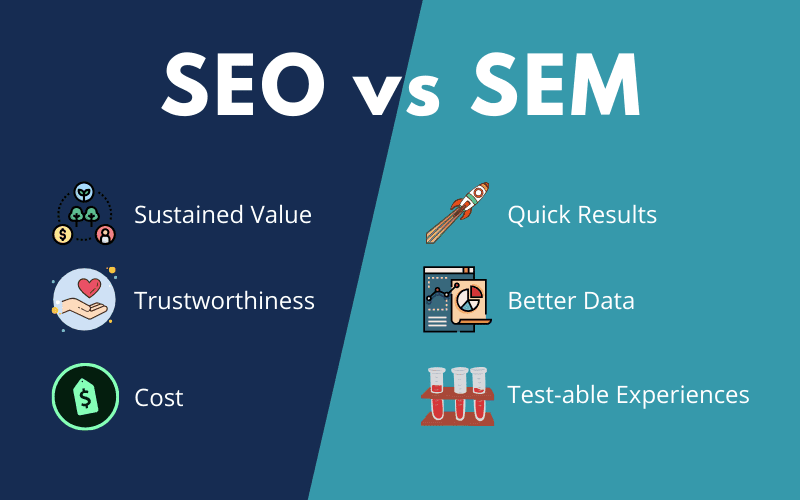
- The advantages of SEO are the sustained value, trustworthiness, and price tag that come with SEO
- The key advantages of SEM are the quick results, deep data, and test-able experiences
- Using a combined search strategy with both SEO and SEM can also be beneficial for many businesses if done well
Before we battle off SEO and SEM, let’s clarify what we mean when we say SEO and SEM.
The Search Engine
A search engine is a place you go to search for something to find relevant results or answers to your questions, where the most common search engines are Google and Bing.
Say you decided tomorrow that you wanted to find the best ice cream shop in your area, you’d probably pop open Google and write something along the lines of “best ice cream shops near me” and you’d get a handful of search results.
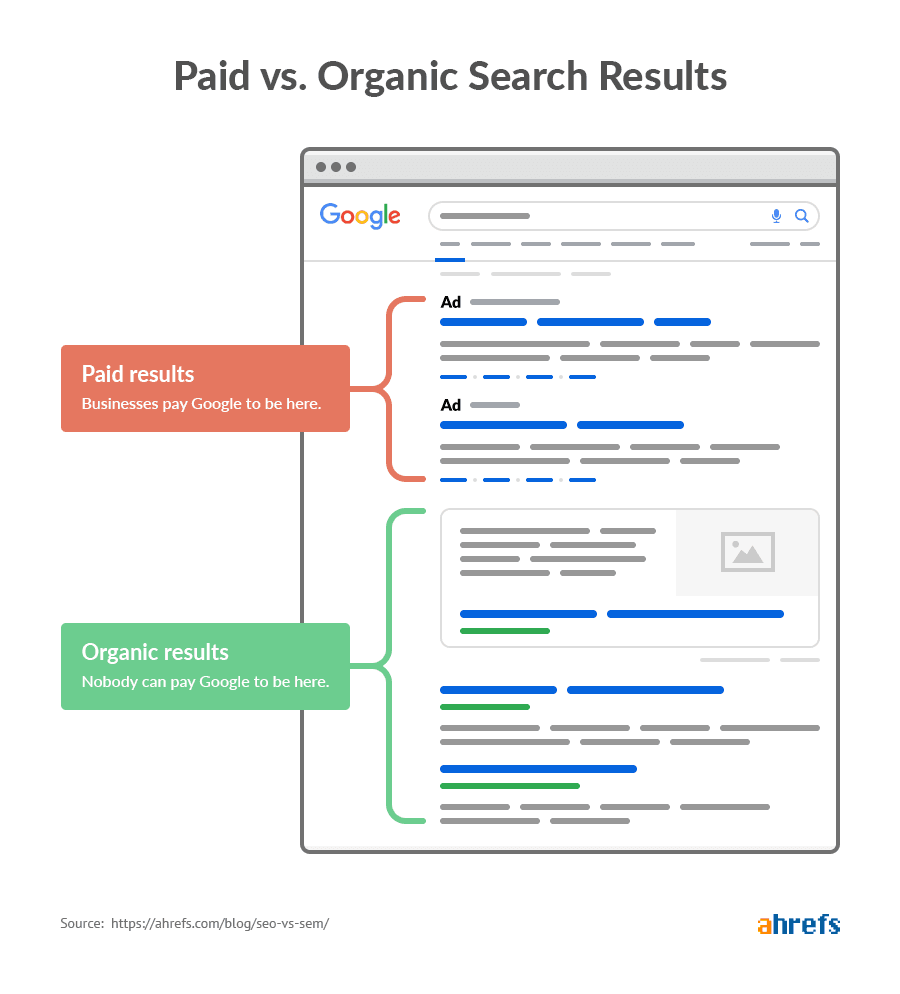
Within those search results, you’d likely see some organic, or unpaid, results and some paid results. The paid results are the ones that say “Ad” next to them and those are paid for by advertisers.
Search Engine Optimization (SEO)
Now that we know what the search engine is, let’s understand what SEO is. SEO is the process of optimizing our site to rank well in the search results. If we run an online store that sells custom water bottles, we’d want to make sure that our site shows up in the organic results of Google (or Bing) when someone searches for custom water bottles.
SEO is a world of its own and there are tons of different components to getting SEO right, but we’ll leave that aside for this article.
SEM / Google Ads
Search engine marketing, commonly just referred to as Google Ads, is the process of paying to show up in the search results. There are lots of terms you might hear that all generally refer to this like paid search, PPC, Google Ads, or SEM.
At a high level, an advertiser can bid for whatever keyword(s) they want and create ads to show up when someone searches for that keyword. In our example of custom water bottles, we could bid for the keyword “custom water bottles” and create an ad to show up when someone searches for that term. As you grow your understanding of Google Ads, you’ll see just how powerful it can be with all kinds of strings and levers you can test and pull to optimize your ads.
Now that we have a basic understanding of what SEO and SEM are let’s dive into the cases for using each of these tools. They are not mutually exclusive at all but both require a fair amount of work and you may find that one works better for your business than another. Let’s start with the case for SEM.
The Case for SEM (Google Ads)
- Quick Results: SEM allows for immediate results as you can launch a campaign in minutes and start generating returns
- Better Data: The data provided for SEM is far superior to organic search, allowing for deeper keyword and competitive insights
- Test-able Experiences: SEM gives you a platform to test different experiences and learn what works for your audience in terms of ad copy, landing pages, and other variables.
1. Quick Results
The search engine can be a difficult place to break into as a newer business, and going the organic route can often take months, if not years. To break into the organic results often requires you to produce ten of thousands of words of relevant, high-quality content on your site for Google to recognize your page and domain highly.
This can be a slow and arduous process. Showing up organically also requires you to build your domain authority with high-quality backlinks from other sites, which is also a challenging task.
While you should definitely go ahead and produce high-quality content for your site and get quality backlinks from other relevant sites, paid search can be a quicker alternative for breaking into the search results.
With paid search, once you go through the steps of setting up an account and determining your strategy you find yourself in the search results within days. While it is no easy feat to run a successful, profitable paid search campaign, the fruits of your labor will show up a lot quicker than an investment in organic search.
2. Better Data
Another huge advantage of paid search relative to organic search is the quality of data that you receive with a paid search account. In recent years, Google has pared down the amount of data they will give users about organic search which makes it really difficult for businesses to make data-driven decisions.
The best Google tools for organic search data are Google Search Console paired with Google Analytics, although it is still limited compared to Google Ads.
The Google Ads platform gives robust data at various levels for you to gather insights and make data-driven decisions for your business. Within the Google Ads platform, you are able to see tons of data at various levels.
You can see performance data for every keyword, competitive and bidding data for every keyword, performance of different ads within ad groups, conversion data for a campaign, and a whole lot more.
You can also use the Competitive Insights tool to see which competitors are outranking you for which keywords, how often you show with different competitors, and more. You can use the keyword planner to find new keywords to invest in. These are just some of the tools available in Google Ads.
3. Test-able Experiences
Using paid search also allows you to test different variants of campaigns including your ad copy and landing pages. Within organic search, Google gets to choose which one of your pages shows up for a certain keyword.
With paid search, you get to choose which page shows up for that keyword. This gives you the ability to test different experiences. Use the Drafts & Experiments tool in Google Ads, you can A/B test different landing pages to determine which page performs better.
For example, when someone searches for “cool t-shirts” you can test sending them to a page with many options for t-shirts or send them to a page with just your 3 best-selling t-shirts. Paid search also gives you the opportunity to test ad copy, the actual content that is shown to the user in the search result.
For the t-shirts example, you may want to lead with “Coolest T-shirts | Shop Online” or you may want to say “Cool T-shirts | Great Prices.” With the ad rotation feature in Google, you can allow Google to rotate different ads and optimize to the best-performing ad.
Now that we know some of the key pros of Google Ads, let’s shift gears and talk about the benefits of SEO.
The Case for SEO
- Sustained Value: Good SEO can generate sustained long-term value once established, where SEM requires continued spend to generate returns.
- Trustworthiness: Organic results come with inherent trustworthiness to the users relative to SEM as it cannot be paid for.
- Cost: While SEO involves work, there is no cost associated with doing SEO, whereas SEM accumulates a cost-per-click.
1. Sustained Value
The first, and arguably, the most important reason to focus your efforts on SEO first is the sustained, long-term value that comes with SEO. While SEO comes with a “price” of its hard work and a long haul, the value generated from good SEO can drive sustainable long-term benefits for a business.
Investing in technical SEO, building backlinks, and creating relevant content will stay with your site forever and hopefully continue to land you at the top of the search results. If you are able to do this well, your website alone will have intrinsic worth because of how it ranks in the search engine.
Having good SEO can bring you a continuous flow of new traffic to your site that you can optimize on and give you new opportunities for growth. The more authoritative and respected your site is, the more easily you can expand into new opportunities.
Say you are a well-respected website for car buying, you will likely have an advantage over a new player if you both were to enter the market for car rentals because your site is already respected within the car industry and has that authority and expertise established.
2. Trustworthiness
Trustworthiness is another key reason for choosing SEO over SEM. Oftentimes, users are skeptical of advertisers and are less willing to click on advertisements because they know they can be bought.
People generally trust the organic results more and understand that those are hard-earned and created by Google’s algorithms. We heavily rely on search engines like Google because we trust that they will return us the best and most relevant results, which is why we as searchers, might have a propensity towards organic results.
While there are plenty of people clicking on search engine ads, there is inherent trustworthiness to a good organic presence on Google.
3. Cost
The last and most obvious reason one would want to invest in SEO before SEM is that it is technically free. While SEO does not come without work and effort, there is technically no cost to doing SEO well.
On the other hand in SEM, you will be paying for every click that comes through your door which will ultimately raise the cost-to-acquire for new customers.
This can be especially difficult for a new business that does not want to spend a ton of money on paid advertising and is looking to drive organic traffic to their site.
Combined Search Strategy
As I said earlier, one of the two strategies might be better suited for your business and needs, but having a combined search strategy can also be tremendously beneficial. With a combined search strategy you can leverage the pros of both SEO and SEM to some degree. Let’s walk through some of the ways you can use a combined search strategy to benefit your business.
1. SEM Short-term, SEO Long-term
If you are a newer business you might be investing a lot of resources into building out your SEO by generating content, improving technical features on your site, and generating backlinks from other sites, but see no results for a while.
Like I said, SEO is long-game and takes time. In the meantime, you could use Google Ads to drive traffic to your site, get all that good keyword and competitor data, and test different experiences. While you are using SEM you can also be investing in your SEO to rise up in the rankings and maybe turn off your Google Ads if you rank highly enough.
2. Keyword Split
Another way to use a combined strategy is to have a strategy that varies by keywords. Say you’ve done your keyword research and you know what you want to rank for, where you currently rank, and what the competition is like.
For some keywords, you might think you could break into the top of the results organically, while other keywords might be too competitive. In this case, you could focus part of your efforts boosting SEO for the SEO-focus keywords and the rest of your efforts and resources on Google Ads for those SEM-focus keywords.
Doing this well requires you to do good keyword research and understand what is going on in the search results. You might find certain keywords with no ads where it might be easy and cheap to show up and you might find keywords that you can rank well for organically.
3. Stack the Box
The final strategy I’ll discuss here is to all-out blitz the search engine with both SEO and SEM. In this case, you’d invest lots of resources into SEO and also allocate a large budget for SEM for those same keywords so that your site shows up in both the paid results and organic results.
I like to call this strategy “stacking the box” because you are filling up multiple spaces in the search results with your site. The success of this strategy depends on your business and the competition. A good opportunity to do this would be if you rank 2nd organically on a certain keyword and the first spot on the ads is relatively cheap.
In this case, you’d show up 1st in the ads and then again second on the organic results. It can be a good way to leapfrog someone that is ranking above you in the first spot.
Recap & Learn More
A lot goes into coming up with the right search strategy and deciding how to allocate your time and resources between different search avenues. Hopefully, this article gives you some more clarity on how and when you’d use different search tactics between SEO and SEM.
To become a master of search join us for our hands-on SEO and Google Ads classes. To learn all of digital marketing see our full suite of digital marketing classes or our digital marketing certificate program.