April 1, 2026Jerron Smith/12 min read

Music Video: Multi-Cam Editing in Premiere Pro

Master Professional Multi-Camera Video Editing Workflows

Multi-Camera Editing Benefits

Time Efficiency

Multi-camera editing prevents time-consuming manual syncing and reduces counter-productive workflows when working with simultaneous camera footage.

Real-Time Switching

Switch between camera angles in real-time during playback for intuitive editing decisions and faster post-production workflows.

Audio Sync Control

Maintain perfect synchronization between audio and video throughout the editing process with built-in sync indicators.

Topics Covered in This Premiere Pro Tutorial:

Creating a Multi-Cam Source Sequence, Editing Multi-Cam, Refining a Multi–cam Edit, Adding B-Roll to a Multi-Cam Project

Exercise Preview

preview multi cam

Exercise Overview

Professional video productions frequently employ multiple cameras to capture scenes from different angles simultaneously, creating dynamic visual narratives that engage audiences more effectively than single-camera setups. However, attempting to edit this footage using traditional single-camera workflows can become an exercise in frustration—requiring manual syncing, constant timeline switching, and painstaking attention to audio alignment.

Multi-camera editing in Premiere Pro transforms this potentially laborious process into an intuitive, streamlined workflow. This feature automatically synchronizes your footage and provides real-time switching capabilities that mirror the experience of directing a live television broadcast. In this comprehensive exercise, you'll master the complete multi-camera workflow: from creating synchronized source sequences to implementing sophisticated editing techniques that maintain perfect audio-video sync throughout your project.

Multi-Camera Editing Workflow

1

Create Multi-Cam Source Sequence

Sync all footage together using audio synchronization with multiple camera sources and master audio file

2

Set Up Multi-Cam Timeline

Configure the timeline for multi-camera editing with proper workspace layout and preview settings

3

Edit and Switch Cameras

Use multi-cam preview to switch between camera angles and make precise cuts throughout the sequence

4

Refine and Add B-Roll

Fine-tune edits with rolling edit tools and integrate additional B-roll footage to enhance the story

Previewing the Final Video

Before diving into the technical workflow, let's examine the professional results you'll achieve by the end of this exercise.

  1. Navigate to the preview file on your Desktop: Class Files > Premiere Pro Intermediate > Multicam—Music Video > Preview Movie and double–click Before You Accuse Me.mp4.

  2. Analyze the professional editing techniques demonstrated in this music video:

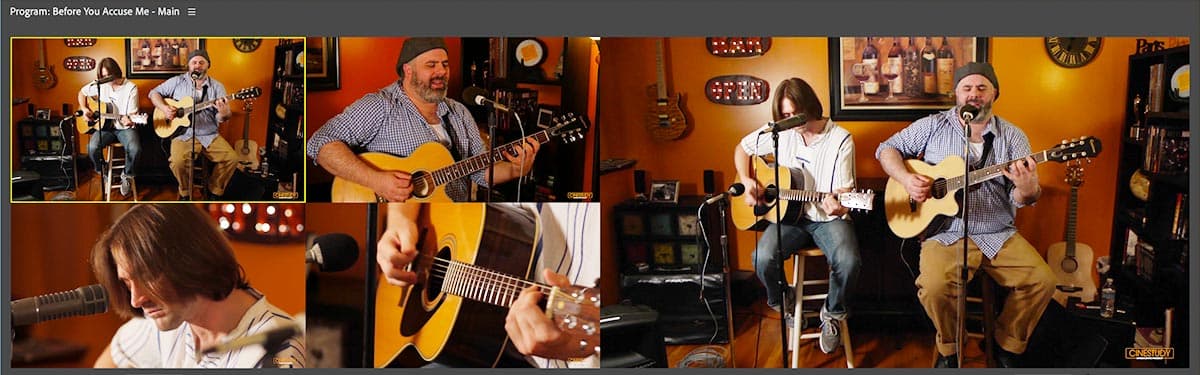
    • At least 4 distinct camera angles capturing the 2 musicians, each contributing unique perspectives and energy to the performance
    • Seamlessly integrated B-roll footage depicting a couple's quarrel, which adds narrative depth and visual interest beyond the performance itself
    • Consistent color grading across all camera sources, creating a cohesive visual aesthetic that unifies the multi-camera footage
  3. Watch the video multiple times, paying attention to the rhythm of the cuts and how they enhance the musical performance. This attention to pacing and musical beats is crucial for effective music video editing.

  4. Close the video when you've thoroughly analyzed the editing patterns and visual storytelling techniques.

Video Elements in Final Project

Camera Sources50%
B-Roll Clips38%
Master Audio13%

Getting Started

Proper project setup is essential for efficient multi-camera workflows. We'll begin with a clean workspace and the provided project files.

  1. If you currently have any projects open in Premiere Pro, choose File > Close All Projects to ensure a clean workspace.

  2. Choose File > Open Project or use the keyboard shortcut Cmd–O (Mac) or CTRL–O (Windows).

  3. Navigate to Desktop > Class Files > Premiere Pro Intermediate > Multicam—Music Video.

  4. Double–click on Before You Accuse Me—Started.prproj to open the starter project.

    NOTE: If you encounter a Converting Project dialog (indicating the project was created in a previous Premiere Pro version), refer to the Fixing Version Compatibility Issues section in Exercise 1A. If the Link Media dialog appears, consult Locating Missing Media in Exercise 1A for resolution steps.

  5. Create your working copy by choosing File > Save As and configure the following:

    • Name the file Before You Accuse Me—Your Name.prproj
    • Save it to Desktop > Class Files > Premiere Pro Intermediate > Multicam—Music Video

Project Setup Requirements

0/4

Creating a Multi–Cam Source Sequence

The foundation of effective multi-camera editing lies in properly synchronizing your source footage. Premiere Pro's multi-camera source sequence feature automatically aligns your clips using audio waveforms, timecode, or markers, creating a unified timeline from which you can make seamless camera switches.

This project includes 4 A/V clips plus a separate master audio file—a common scenario in professional music video production where a high-quality audio recording is captured independently of the cameras.

  1. Optimize your workspace by choosing Window > Workspaces > Editing.
  2. Reset your layout with Window > Workspaces > Reset to Saved Layout to ensure consistency.
  3. In the Project panel, expand the 01—Video bin by clicking its disclosure arrow.

  4. Similarly, expand the A Roll bin to reveal the camera footage.

  5. Expand the 02—Audio bin to access the master audio track.

  6. Select the audio file Peter John Ross_Ian Ross… as your master audio reference.

    PRO TIP: When working with both A/V clips and standalone audio files, selecting the standalone audio first designates it as the master audio source for synchronization. This typically provides superior audio quality compared to camera-recorded audio.

  7. Hold down Cmd (Mac) or CTRL (Windows) and select the camera files in the following order to establish your camera hierarchy:

    • BYAM cam 1.mp4
    • BYAM cam 2.mp4
    • BYAM cam 3.mp4
    • BYAM cam 4.mp4
  8. Release the modifier key when all files are selected.
  9. Access the multi-camera creation dialog by CTRL–clicking (Mac) or Right–clicking (Windows) on any highlighted file and choosing Create Multi-Camera Source Sequence.
  10. Configure the multi-camera sequence with these professional settings:

    • Change the name to Before You Accuse Me—Multicam
    • Set the prefix menu to Custom to maintain clean naming conventions
    • Under Synchronize Point, select Audio for waveform-based synchronization
    • Set Track Channel to Mix Down for optimal audio analysis
    • Confirm Sequence Preset is set to Automatic to match your source footage specifications
    • Uncheck Move source clips to Processed Clips bin to maintain your current organization
    • Under Audio, set Sequence Settings to Camera 1
    • Keep Audio Channels Preset at Automatic
    • Under Camera Names, choose Use Clip Names for clear identification
  11. Click OK to generate your synchronized multi-camera source sequence.

Audio Synchronization Priority

When selecting both A/V clips and a standalone audio file, the standalone audio becomes the master audio source for synchronization. This ensures the highest quality audio reference for multi-camera sync.

Multi-Cam Sequence Creation Process

1

Select Master Audio

Choose the standalone audio file first to establish it as the synchronization master

2

Add Camera Files in Order

Select all four camera MP4 files while holding Cmd/Ctrl to maintain organization

3

Configure Sync Settings

Set synchronization to Audio with Mix Down track channel for optimal sync accuracy

4

Finalize Sequence Settings

Use automatic presets and clip names for camera identification in the multi-cam setup

Setting up for Multi-Cam Editing

Multi-camera source sequences function differently from standard sequences—they're designed to act as intelligent clips that contain multiple camera angles. To edit effectively, you'll need to create a new sequence that references your multi-cam source.

  1. In the Project panel, CTRL–click (Mac) or Right–click (Windows) on the Before You Accuse Me—Multicam sequence and select New Sequence From Clip.

  2. Notice that your Project panel now contains two items named Before You Accuse Me—Multicam with distinct icons:

    • sequence icon represents the editing sequence (currently selected)
    • multicam sequence icon represents the multi-camera source sequence
  3. Rename the editing sequence by CTRL–clicking (Mac) or Right–clicking (Windows) on the sequence icon sequence and choosing Rename.
  4. Name it Before You Accuse Me—Main to clearly identify your primary editing sequence.
  5. Organize your project by dragging Before You Accuse Me—Multicam onto the New Bin button new_bin at the bottom right of the Project panel.
  6. Rename the new bin 04—Nested Sequences to maintain professional project organization.
  7. In the Timeline panel, position the playhead at 10:00 to trim the intro silence.
  8. Remove the unwanted beginning by pressing Q to execute a ripple trim to the playhead position.

  9. Navigate to 3:44:20 to mark the end of usable content.

  10. Trim the ending by pressing W to ripple trim from the playhead to the sequence end.

  11. Activate multi-camera preview mode by clicking the wrench button button_wrench at the bottom right of the Program panel and choosing Multi-Camera.

  12. Select the Selection tool tool_selection for precise clip manipulation.
  13. Click on the Before You Accuse Me—Multicam clip in the Timeline to select it.
  14. Unlink the audio and video by CTRL–clicking (Mac) or Right–clicking (Windows) on the clip and choosing Unlink. This allows independent manipulation of video cuts while preserving audio continuity.
  15. Lock the Audio 1 track button_lock to prevent accidental audio edits during video switching.
  16. Deselect all clips by clicking on an empty Timeline area.
  17. Optimize your Timeline view by holding Shift and pressing + (plus) to expand all track heights simultaneously.
  18. Zoom in for precision editing by pressing + (plus) several times.
  19. Position the playhead at 1:00:00 for reference.
  20. Add a visual reference marker by pressing M on the keyboard.

    NOTE: This marker serves as a reference point for the upcoming editing exercise, marking the one-minute point where your multi-camera cuts will begin.

  21. Save your progress with File > Save or Cmd–S (Mac) / CTRL–S (Windows).

Multi-Cam Sequence Usage

Multi-cam sequences function as clips rather than standard sequences. Always create a new sequence from the multi-cam clip for actual editing work.

Timeline Preparation Steps

Trim Unwanted Sections

Use Q and W keys for ripple trimming to remove footage before and after desired content sections.

Unlink and Lock Tracks

Unlink the multi-cam clip and lock audio track to prevent accidental audio modifications during video editing.

Editing a Multi-Cam Sequence

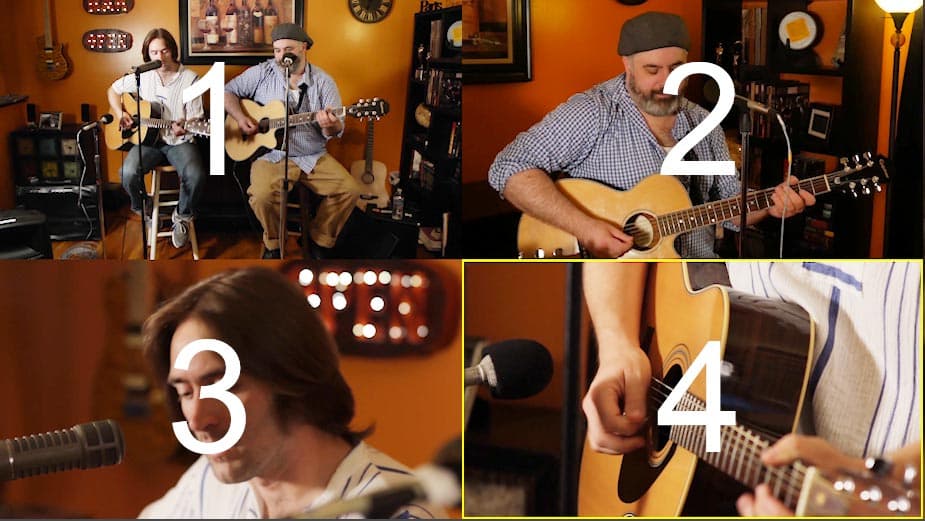
With your multi-camera setup complete, you can now experience the power of real-time camera switching. The multi-camera preview in the Program panel displays all camera angles simultaneously, allowing you to make editorial decisions based on visual content rather than guesswork. This workflow mirrors professional live television production, where directors switch between cameras in real-time to create dynamic coverage.

multicam_4up

  1. Return the playhead to the Timeline beginning to start your edit sequence.
  2. In the Program panel's multi-camera view, click on Camera 4 to establish it as your opening shot.

  3. Create your first camera switch at 5:09:

    • Execute a cut using Cmd–K (Mac) or CTRL–K (Windows)
    • Switch to Cam 2 (top right quadrant) for a fresh perspective
  4. Continue building your edit sequence at 10:14:

    PRO TIP: For rapid timecode navigation on keyboards with numeric keypads, simply type the desired timecode directly—no need to click in the timecode field first. Ensure no clips are selected to avoid accidentally moving them.

    • Cut the timeline with Cmd–K (Mac) or CTRL–K (Windows)
    • Activate Cam 1 for your next angle

    EFFICIENCY TIP: Use the number keys (1-4) in the top row of your keyboard to quickly switch between camera angles. This is significantly faster than clicking and essential for maintaining editing flow.

  5. Add another cut at 14:05:

    • Execute your cut with Cmd–K (Mac) or CTRL–K (Windows)
    • Return to Cam 2 for visual variety
  6. Complete this editing sequence at 17:05:

    • Make your final cut with Cmd–K (Mac) or CTRL–K (Windows)
    • Switch back to Cam 1
  7. Review your work by playing through the edit sequence. Notice how the camera switches create visual rhythm and maintain viewer engagement. The timing may need refinement, which we'll address in the next section.

    NOTE: Professional music video editing requires many more camera switches to maintain visual interest throughout the song. For time efficiency, we'll provide a project file with additional switches already implemented.

  8. Save your progress using File > Save or Cmd–S (Mac) / CTRL–S (Windows).

Keyboard Shortcuts for Camera Switching

Press number keys 1-4 on the top row of your keyboard to quickly switch between cameras. Use Cmd+K or Ctrl+K to cut clips at the playhead position.

Sample Edit Sequence

0:00

Start with Camera 4

Establish opening shot

5:09

Cut to Camera 2

Switch angle at 5:09

10:14

Switch to Camera 1

Change perspective at 10:14

14:05

Return to Camera 2

Continue coverage at 14:05

Refining a Multi–Cam Edit

Initial camera switches provide the foundation, but professional-quality results require careful refinement. The key principle in multi-camera editing is preserving sync between audio and video sources while fine-tuning the timing and flow of your cuts. Even small adjustments to cut points can dramatically improve the visual rhythm and storytelling impact.

  1. Close your current project with File > Close All Projects to transition to the refinement phase.

  2. Open the enhanced project file using File > Open Project or Cmd–O (Mac) / CTRL–O (Windows).

  3. Navigate to Desktop > Class Files > Premiere Pro Intermediate > Multicam—Music Video.

  4. Double–click Before You Accuse Me—Ready to Refine.prproj to access the project with additional camera switches.

  5. Create your working copy using File > Save As:

    • Name the file Before You Accuse Me—Your Name.prproj
    • Save to Desktop > Class Files > Premiere Pro Intermediate > Multicam—Music Video (replacing any existing file)
  6. Reactivate multi-camera view by clicking the wrench button button_wrench in the Program panel and selecting Multi-Camera.

  7. Enable sync monitoring through Timeline Preferences:
    • Mac: Navigate to Premiere Pro menu → SettingsTimeline (or PreferencesTimeline in older macOS versions)
    • Windows: Go to Edit menu → PreferencesTimeline
  8. Check Display out of sync indicators for unlinked clips and click OK. This critical setting provides visual warnings if your edits break sync relationships.

  9. Analyze the footage quality at 5:00 by positioning your playhead there.

    Notice the blurry footage—this represents the type of quality issue that requires editorial correction.

  10. Find better footage quality at 4:12 and mark this as your preferred cut point.

    • Select the Rolling Edit tool tool_roll_edit for sync-safe editing
    • Drag the edit line between the first two clips to the playhead position
  11. Verify your edit using Shift–K to preview the area around the cut point. The Rolling Edit tool intelligently shortens one clip while lengthening the adjacent clip, maintaining perfect sync throughout.

  12. Address another quality issue by navigating to 57:08.

    • Observe the problematic blurry lights at the end of the camera 4 clip [MC4]
  13. Establish a better end point at 56:14:

    • Using the Rolling Edit tool tool_roll_edit, drag the edit line after MC4 to the playhead, eliminating the unwanted footage
    • Preview the correction using Shift–K to confirm improved visual quality while maintaining sync
  14. Return to the Selection tool tool_selection for additional editing operations.
  15. Demonstrate camera source switching at 46:06:

    • CTRL–click (Mac) or Right–click (Windows) on the clip to the right of the playhead
    • Choose Multi-Camera[1]BYAM cam 1.mp4 to change the camera source for this segment without affecting timing
  16. Preserve your refined edit with File > Save or Cmd–S (Mac) / CTRL–S (Windows).

Maintain Audio-Video Sync

The most critical aspect of multi-cam editing is preserving synchronization between audio and video tracks throughout the refinement process.

Refinement Techniques

Rolling Edit Tool

Adjust edit points while maintaining clip lengths and sync. Drag edit lines to new positions for precise timing.

Out of Sync Indicators

Enable timeline preferences to display sync indicators for unlinked clips, helping identify potential sync issues.

Camera Source Switching

Change camera sources for existing clips through right-click context menu without affecting timing or sync.

Adding B-Roll to a Multi-Cam Edit

B-roll footage elevates music videos from simple performance documentation to compelling visual storytelling. By incorporating narrative elements that complement the song's themes, you create emotional depth and maintain visual interest throughout the piece. The key is integrating B-roll seamlessly while preserving the musical performance's audio track.

  1. Switch to standard editing view by clicking the wrench button button_wrench in the Program panel and selecting Composite Video.

  2. Establish your first B-roll placement from 22:09:

    • Press I to mark the In point
  3. Complete the selection at 28:19:

    • Press O to set the Out point, creating a precisely timed segment for B-roll insertion
  4. Access your B-roll assets by expanding the 01—Video bin in the Project panel.

  5. Open the B-Roll bin to reveal your narrative footage options.

  6. Load the first B-roll clip by double-clicking Couple Having a Quarrel 01.mp4 in the Source panel.

  7. Find the optimal starting point at 7:00 in the Source panel:

    • Press I to set an In point, ensuring you start with the most impactful moment
  8. Execute a video-only overlay edit by dragging the Drag Video Only button drag_video_only to the Program panel and dropping it on Overlay. This preserves your music track while replacing the video content.

  9. Set up your second B-roll segment from 34:00:

    • Press I to establish the In point
  10. Define the segment end at 40:09:

    • Press O to set the Out point
  11. Load the continuation of your story by double-clicking Couple Having a Quarrel 02.mp4 in the Project panel.

  12. Insert this B-roll segment by dragging the Drag Video Only button drag_video_only to the Program panel and selecting Overlay.

    NOTE: Without setting a new In point, Premiere Pro automatically uses the clip's beginning, which works perfectly for narrative continuity.

  13. Create your final B-roll placement from 49:09:

    • Press I to mark the In point
  14. Complete the selection at 55:05:

    • Press O to set the Out point
  15. Access the concluding narrative footage by double-clicking Couple Having a Quarrel 03.mp4 in the Project panel.

  16. Optimize the starting point by positioning the Source panel playhead at 0:05:

    • Press I to set a refined In point
  17. Complete your B-roll integration by dragging the Drag Video Only button drag_video_only to the Program panel and selecting Overlay.

  18. Review your complete multi-camera music video by playing the first minute, observing how the camera switches and B-roll insertions work together to create engaging visual storytelling.

  19. Finalize your project with File > Save or Cmd–S (Mac) / CTRL–S (Windows).

B-Roll Integration Process

1

Set Timeline In/Out Points

Mark specific sections where B-roll will overlay the multi-cam footage using I and O keys

2

Prepare Source Clips

Open B-roll clips in source monitor and set In points for precise content selection

3

Overlay Video Only

Use Drag Video Only button to overlay B-roll while preserving original audio track

B-Roll Placement Timeline

Quarrel Scene 1
22
Quarrel Scene 2
34
Quarrel Scene 3
49

Key Takeaways

1Multi-camera editing in Premiere Pro significantly reduces time consumption compared to manual syncing methods for projects with simultaneous camera footage
2Audio synchronization serves as the foundation for multi-cam sequences, with standalone audio files taking priority as master sync sources over camera audio
3Multi-cam sequences function as clips rather than standard sequences, requiring the creation of new sequences from multi-cam clips for actual editing work
4Real-time camera switching allows intuitive editing decisions during playback, though cuts are not visible until playback stops and require subsequent refinement
5The Rolling Edit tool is essential for refining multi-cam edits while maintaining critical audio-video synchronization throughout the project
6B-roll integration enhances multi-cam projects by breaking visual monotony and supporting narrative elements using video-only overlay techniques
7Keyboard shortcuts for camera switching (number keys 1-4) and cutting (Cmd/Ctrl+K) streamline the multi-cam editing workflow significantly
8Timeline preferences for out-of-sync indicators help maintain professional quality by identifying potential synchronization issues with unlinked clips

RELATED ARTICLES