Working Capital
Working Capital Components
Accounts Receivable
Money owed by customers — DSO measures collection speed.
Inventory
Goods held for sale — DIO measures days to turn over.
Accounts Payable
Money owed to suppliers — DPO measures payment speed.
Cash Conversion Cycle
DSO + DIO - DPO. Lower is better for liquidity.
Noble Desktop's Financial Analyst Training Program covers financial modeling, valuation, accounting, and Excel for finance.
Gain insight into the concept of working capital, including the definition, calculations, and implications for a company's financial health, growth potential, and operational efficiency.
- Working capital, also known as Net Working Capital (NWC), is the difference between a company’s current assets and its current liabilities
- Working Capital = Current Assets – Current Liabilities
- Current Liabilities—cash, accounts receivable, inventories of raw materials and finished goods
- Current Assets—accounts payable and short term debts needed to be paid within a year
- Working capital is a measure of a company’s liquidity, operational efficiency, and short-term financial health.
- If a company has substantial positive working capital, then it should have the potential to invest and grow
- If a company’s working capital is negative, then it may have trouble growing or paying back creditors, or even go bankrupt.
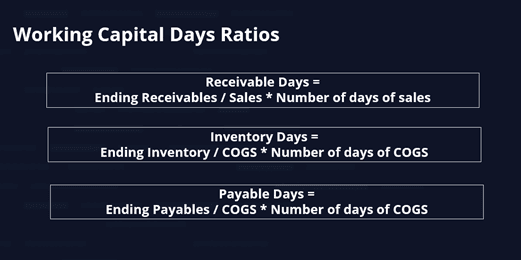
Day calculations or ratios are measures of efficiency and provide an insight into how long cash is tied up for in a business. The calculations are based on three key components of the day-to-day operations of a business: inventories, receivables and payables. These items are analyzed by calculating them as a percentage of sales and cost of goods sold respectively.
Receivable Days = (Ending Receivables / Sales) * Number of days of sales
Many companies provide a credit period on sale and receivable days to show how long on average customers are taking to pay. It is calculated as the ending receivables balance, divided by sales for the reported period, multiplied by the number of days the sales represent. Often the number of days is 365, which represents one full year of business operations.
Inventory Days = (Ending Inventory / Cost of Goods Sold) * Number of days of cost of goods sold
Inventory days provide the number of days of selling possible before the warehouse is emptied. This metric gives a good indication of whether a company is needlessly holding onto its inventory. Holding inventory in warehouses incurs costs to the business and might also indicate if the business is holding potential cash as unsold stock, which could be better used in other operations.
Payable Days = (Ending Payables / Cost of Goods Sold) * Number of days of cost of goods sold
Payables show the average number of days the business is taking to discharge its obligations to suppliers. A high positive number indicates the company has a free source of funding and can use that cash it owes to cover other costs. However, a low or even negative number suggests the business is not meeting the payment deadlines for its obligations.
Working Capital Days = Receivable Days + Inventory Days – Payable Days
This ratio measures how efficiently a company is able to convert its working capital into revenue. The higher the number of days, the longer it takes for that company to convert to revenue. It shows how long cash is tied up in the companies working capital.