April 1, 2026/2 min read

Discount Factor

Master present value calculations for investment analysis

Key Concept

The discount factor is fundamental to NPV calculations, representing how much future money is worth in today's terms. It always falls between zero and one due to the time value of money principle.

Understanding Discount Factor Components

Present Value Focus

Discount factor converts future cash flows into today's monetary value. This allows for accurate comparison of investments across different time periods.

Time Value Impact

Money loses value over time due to inflation and opportunity costs. The discount factor quantifies this reduction mathematically.

Range Limitation

Values always fall between zero and one, with higher discount rates producing lower factors. This reflects increased uncertainty over longer time periods.

Enterprise Value Calculation Process

1

Calculate Discount Factor

Use the formula =1/(1+discount_rate)^period to determine the present value multiplier for each time period

2

Apply to FCF and Terminal Value

Multiply the discount factor by the sum of Free Cash Flow and Terminal Value using =discount_factor*SUM(FCF:TV)

3

Sum All Discounted Values

Add all discounted cash flows across all periods to arrive at the total Enterprise Value

The discount factor measures the present value of an investment's future worth
This fundamental definition explains why discount factors are essential for comparing investments with different cash flow timing and risk profiles.

Discount Factor Method

Pros
Accounts for time value of money accurately
Enables comparison of different investment opportunities
Incorporates risk through discount rate selection
Provides standardized valuation framework
Cons
Requires accurate discount rate estimation
Sensitive to input assumptions
May not capture all market dynamics
Complex for non-financial professionals

Implementation Checklist

0/5

To accurately calculate an investment's net present value (NPV), you must first master the concept of the discount factor—arguably the most critical component in discounted cash flow (DCF) analysis. The discount factor represents the present value of money that will be received in the future, accounting for the time value of money principle that forms the bedrock of corporate finance.

Every discount factor calculation operates on a fundamental economic reality: a dollar today is worth more than a dollar tomorrow. This deterioration in purchasing power stems from multiple factors—inflation, opportunity cost, and inherent investment risk—which collectively ensure the discount factor always falls between zero and one. The closer to one, the less time or risk involved; the closer to zero, the more distant or uncertain the future cash flow becomes.

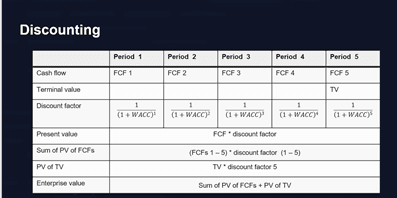
Now that we've established the theoretical foundation, let's examine the practical application. Here's how you can leverage the discount factor to transform projected Free Cash Flow (FCF) and Terminal Value (TV) into a comprehensive Enterprise Value calculation:

Picture1

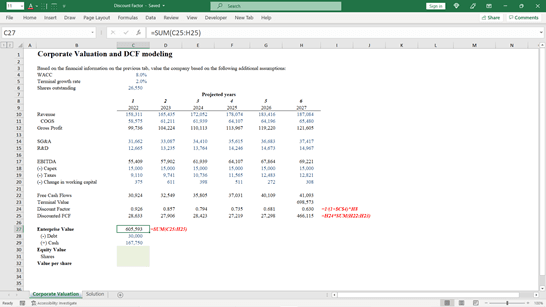
The mathematical execution follows a straightforward three-step process. First, we calculate the discount factor using the formula: =1/(1+$C$4)^C8. This formula divides one by the discount rate (typically your Weighted Average Cost of Capital) raised to the power of the time period, giving us the present value multiplier for each future year.

Next, we apply this discount factor to our projected cash flows and terminal value: =C24*SUM(C22:C23). This step converts those future dollars into today's equivalent value, accounting for both the time delay and the risk inherent in achieving those projected returns.

Finally, we aggregate all discounted values to arrive at our Enterprise Value: =SUM(C25:H25). This sum represents the total economic value of the business based on its projected ability to generate cash flow over time.

Screenshot of a Microsoft Excel workbook titled 'Corporate Valuation and DCF modeling.' The spreadsheet shows key assumptions (like WACC and terminal growth rate) alongside projected financial data—including revenue, COGS, operating expenses, and discounted cash flow calculations—ultimately deriving a value per share.

Key Takeaways

1Discount factor is essential for calculating NPV and represents present value of future investment worth
2The discount factor formula is 1/(1+discount_rate)^period, always yielding values between zero and one
3Time value of money principle drives discount factor calculations due to inflation and opportunity costs
4Enterprise Value calculation requires applying discount factors to both FCF and Terminal Value
5The three-step process involves calculating discount factors, applying to cash flows, and summing results
6Proper discount rate selection is critical for accurate valuation and investment comparison
7Discount factors enable standardized comparison of investments across different time horizons and risk profiles
8Implementation requires careful attention to cash flow projections, terminal value calculations, and consistent application

RELATED ARTICLES