April 1, 2026/2 min read

Synergies to prevent Dilution

Strategic Mergers Creating Value Beyond Individual Parts

Core Concept

Synergy represents the fundamental principle that combined business entities can achieve performance levels that exceed the sum of their individual capabilities through strategic integration.

Primary Synergy Categories

Revenue Synergy

Combined companies generate higher revenues through expanded market reach, cross-selling opportunities, and enhanced product offerings that neither could achieve independently.

Cost Synergy

Merged entities eliminate redundant processes, consolidate operations, and achieve economies of scale resulting in significant operational cost reductions.

Operational Synergy

Integration of talent, technology, and resources creates enhanced efficiency and streamlined processes that improve overall business performance.

Independent vs Synergistic Operations

FeatureSeparate CompaniesMerged Entity
Revenue PotentialLimited to individual marketsExpanded market access
Cost StructureDuplicate overhead costsConsolidated operations
Resource UtilizationIndividual capabilitiesCombined talent and technology
Market PositionCompetitive against each otherUnified competitive advantage
Recommended: Synergistic mergers create value through elimination of redundancies and leveraging combined strengths

Synergy Realization Process

1

Identify Synergy Sources

Analyze potential revenue enhancement opportunities, cost reduction areas, and operational improvements that merger could enable

2

Quantify Expected Benefits

Calculate projected financial impact of increased revenues, combined resources, and elimination of redundant processes

3

Execute Integration Strategy

Implement merger combining talent and technology while streamlining operations to achieve greater efficiency and scale

4

Measure Performance Gains

Monitor actual results to ensure combined entity delivers performance exceeding sum of individual company capabilities

Synergy Merger Considerations

Pros
Creates greater efficiency through elimination of redundant processes
Enables achievement of scale not possible for individual companies
Combines talent and technology for enhanced capabilities
Generates revenue opportunities beyond individual company reach
Results in significant cost reduction through streamlined operations
Cons
Integration complexity may delay realization of expected benefits
Cultural differences between companies can hinder synergy achievement
Actual performance may not meet projected synergy expectations
Initial costs of merger execution can be substantial
Market disruption during transition period may impact operations

Synergy Evaluation Framework

0/5
Two companies can merge to create greater efficiency or scale, the result is what is sometimes referred to as a synergy merge
The fundamental definition of synergistic mergers demonstrates how strategic combinations create enhanced business entities that outperform individual company limitations through integrated operations and shared resources.

  • Synergy represents the fundamental principle that when two companies combine, their collective value and operational performance should exceed what they could achieve as separate entities—essentially making 1+1 equal 3 in business terms.
  • While synergy applies across various business contexts, it has become the cornerstone concept driving modern mergers and acquisitions (M&A) strategy, with deal values in 2025 reaching unprecedented levels as companies seek competitive advantages through combination.
  • Strategic combinations allow businesses to unlock revenue streams neither could access independently—whether through expanded market reach, cross-selling opportunities, or enhanced product portfolios—while simultaneously eliminating operational redundancies that can reduce costs by 15-30% in successful integrations.
  • When two companies merge specifically to achieve greater operational efficiency or market scale, investment professionals refer to this as a synergy merger, distinguishing it from acquisitions driven purely by financial engineering or market consolidation.
  • The synergy potential realized through strategic combinations typically stems from four key value drivers: accelerated revenue growth through market expansion, enhanced human capital and technological capabilities, significant cost reduction through operational efficiencies, and improved competitive positioning that commands premium pricing power in the marketplace.

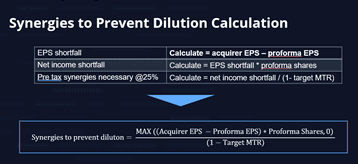
Understanding how to quantify and model these synergies becomes crucial for deal evaluation and post-merger integration planning. The following calculation framework demonstrates how to determine the minimum synergies required to prevent earnings dilution—a critical threshold that investment committees and boards closely monitor.

Infographic titled 'Synergies to Prevent Dilution Calculation' showing formulas for EPS shortfall, net income shortfall, required pre-tax synergies at 25%, and a final synergy formula.

The practical application of synergy calculations requires precise modeling to ensure deal economics meet investor expectations. Here's how senior finance professionals structure the key formulas using Excel for rapid scenario analysis:

B31=B27

B32=B15

B33=MAX(B32-B31,0)

B34=B33*B25

B35=B34/(1-C13)

B36=MAX((B32-B31)*B25/(1-C13),0)

These formulas create a dynamic model that allows deal teams to stress-test various synergy assumptions against different market scenarios, ensuring that projected benefits remain achievable under realistic operating conditions. The MAX functions provide downside protection by preventing negative synergy requirements, while the tax adjustment factor ensures all calculations reflect after-tax impact on shareholder value.

Key Takeaways

1Synergy represents the principle that combined company value and performance exceeds the sum of individual parts through strategic integration
2Mergers and acquisitions utilize synergy concepts to create entities capable of producing greater revenue than separate companies could achieve independently
3Cost reduction through elimination of redundant processes forms a primary driver of synergistic value creation in business combinations
4Revenue synergies emerge from increased market access, combined talent utilization, and enhanced technology integration following strategic mergers
5Synergy mergers focus on creating greater operational efficiency and achieving business scale impossible for individual companies to attain
6Expected synergy achievement depends on successful integration of various factors including expanded revenues, consolidated resources, and streamlined operations
7The concept of synergistic value creation serves as the foundational justification for merger and acquisition strategies in corporate finance
8Combined entities must demonstrate performance levels that definitively surpass what separate companies could accomplish through independent operations

RELATED ARTICLES