Strategic v. Financial Buyer
Strategic vs Financial Buyers
| Feature | Characteristics |
|---|---|
| Strategic Buyer | Operating company seeking synergies. Often pays premium for revenue or cost synergies. |
| Financial Buyer (PE) | Investment fund seeking returns through growth, leverage, and exit. More cost-discipline focused. |
Noble Desktop's Financial Analyst Training Program covers financial modeling, valuation, accounting, and Excel for finance.
Discover the difference between strategic and financial buyers, their unique approaches to business acquisitions, and how they generate returns on investment.
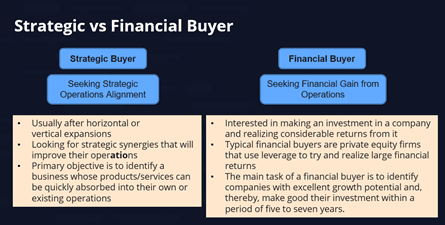
Strategic Buyer
A strategic buyer is interested in how the acquired firm aligns with it’s long-term business plans. There can be different reasons for acquiring a new company such as for vertical integration (geared toward clientele or suppliers), horizontal expansion (exploring new markets or product lines), getting rid of competitors, or helping to eliminate or overcome market weaknesses of the acquiring company.
Often, strategic buyers are willing to pay more for companies than financial buyers. One reason is that a strategic buyer is better placed to realize synergistic benefits almost instantly. This is because of the economies of scale that may arise from integrated operations. The more the acquired business fits into the existing company’s structure, the more a strategic buyer will want the business and the higher the premium he will be willing to pay.
In addition, strategic buyers are usually large and well-established companies with easier access to capital. As a result, they may possess a different currency, in the form of stock. In fact, a strategic buyer can pay for the acquisition by purchasing stock, paying cash, paying stock or through some combination of purchase methods.
Financial Buyer
A financial buyer views an acquisition as an investment. They are looking to invest up to a certain amount of money in acquiring the target company, and then expect that investment to generate a satisfactory return. The financial buyer is open to investing in different kinds of businesses and industries rather than only those that align with its existing operations.
A financial buyer looks to increase his revenues and cash flow through different techniques, including venturing into revenue-generating projects, reducing expenses, and creating economies of scale. Once the financial buyer reaps maximum returns from its initial investment, he is likely to exit the company, either by taking it public or selling it outright.
To ensure the financial buyer gets a return on his investment, a it must start by examining the financial records of the company it intends to buy. The one thing that the buyer is interested in is seeing consistency in the target company’s financial statements.
Often, a financial buyer uses borrowed funds to finance acquisition deals. It is not unusual to see a financial buyer using as much as 80% debt for the target company’s acquisition. This kind of transaction is called an LBO or Leveraged Buyout.