March 23, 2026/4 min read

Google Ads: Responsive Search Ads

Master Machine Learning Powered Ad Optimization Strategies

Machine Learning Revolution

Responsive Search Ads represent a fundamental shift from manual ad creation to automated optimization, leveraging Google's machine learning algorithms to improve ad performance.

Responsive Search Ads represent a paradigm shift in Google Ads campaign management, leveraging sophisticated machine learning algorithms to optimize ad copy performance dynamically. To fully appreciate their strategic value, it's essential to understand how they fundamentally differ from their predecessor: Expanded Text Ads.

Expanded Text Ads

Expanded Text Ads (ETAs) have long served as the foundation of Google Ads campaigns, offering advertisers predictable control over their messaging. With ETAs, you craft exactly three headlines (30 characters each) and two descriptions (90 characters each) — a significant improvement over the original text ad format that earned them the "expanded" designation. The primary appeal of ETAs lies in their static nature: what you create in the interface is precisely what users see in search results, without variation. This predictability allows for meticulous brand control and message consistency, making ETAs particularly valuable for campaigns requiring exact compliance messaging or highly specific value propositions. However, this rigidity also represents their greatest limitation — they cannot adapt to the nuanced variations in user search behavior that could improve relevance and performance.

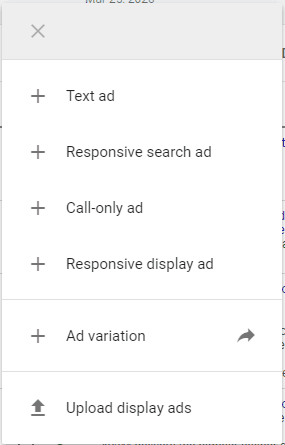
Google Ads Ad Types

ETA Specifications

Headlines

Create up to 3 headlines with 30 characters each. You have complete control over what appears and when.

Descriptions

Write up to 2 descriptions with 90 characters each. Static content that never changes based on search queries.

Preview Control

See exactly how your ad will appear in search results. What you create is exactly what users will see.

Responsive Search Ads

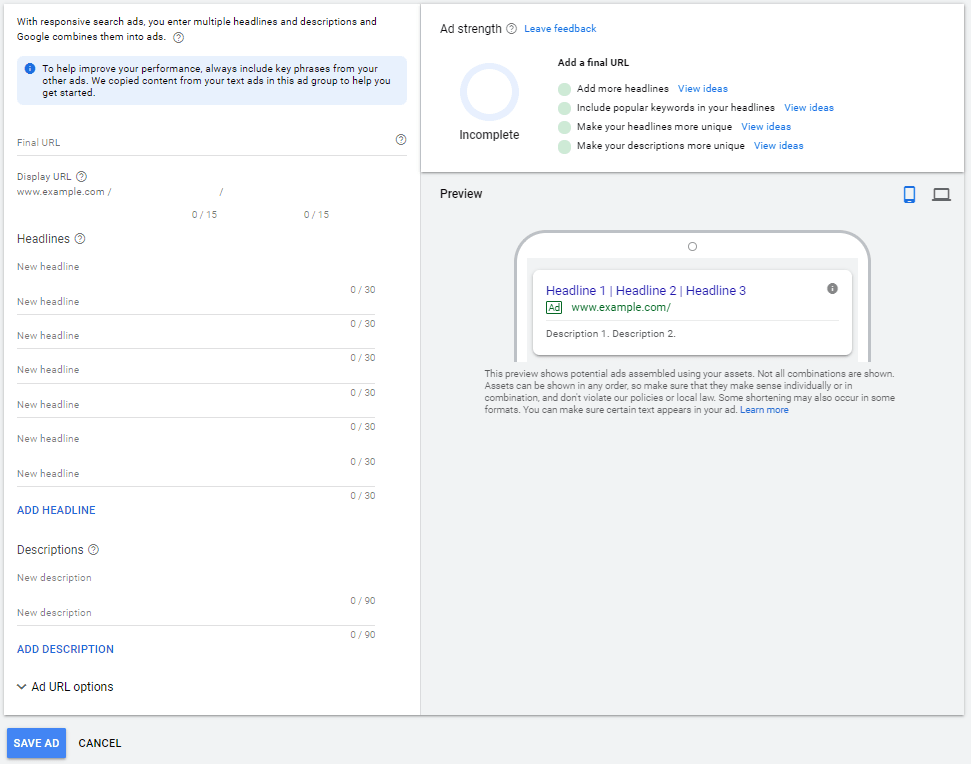
Responsive Search Ads (RSAs) fundamentally reimagine how search ads operate by introducing dynamic adaptability powered by Google's advanced machine learning systems. Rather than creating fixed ad combinations, RSAs allow you to input up to 15 unique headlines and 4 descriptions, creating a content library from which Google's algorithms can dynamically generate optimized ad variations in real-time. This approach enables each ad to respond intelligently to individual search queries, user contexts, and performance signals that human advertisers might miss or cannot scale effectively. The system continuously tests different headline and description combinations, learning which variations drive the best performance for specific search intents, device types, geographic locations, and user demographics. By 2026, these machine learning models have become significantly more sophisticated, incorporating user journey data and cross-platform behavioral signals to make increasingly precise optimization decisions that often exceed human-managed performance benchmarks.

Responsive Search Ad

ETA vs RSA Capabilities

FeatureExpanded Text AdsResponsive Search Ads
Headlines3 headlinesUp to 15 headlines
Descriptions2 descriptionsUp to 4 descriptions
Ad VariationsStatic contentDynamic combinations
Control LevelFull controlMachine learning optimization
Auction ParticipationLimited relevanceImproved relevance matching
Recommended: Use RSAs to capture more auction opportunities while maintaining ETAs for proven high-performing messaging.
Machine Learning Advantage

Google's algorithms automatically test different headline and description combinations to find the most effective ad variations for each individual search query, potentially improving your quality score and ad relevance.

Example

Consider a premium watch retailer targeting the broad match keyword "watches." With a traditional ETA featuring the headline "Best Watches | Shop Online Now," the ad maintains consistent messaging but may struggle with relevance across diverse search intents. When a user searches "luxury Swiss watches," the generic "best watches" messaging lacks the specificity that drives quality scores and conversion rates. However, with RSAs containing multiple targeted headlines like "Luxury Swiss Timepieces," "Certified Swiss Movements," and "Premium Watch Collection," Google's algorithms can dynamically select the most relevant combination for each query. For a search like "affordable luxury watches," the system might pair "Premium Watch Collection" with a description emphasizing value, while "Swiss watch repair" might trigger headlines about craftsmanship and service. This dynamic optimization typically results in 10-15% higher click-through rates and improved Quality Scores across keyword portfolios, as the ads demonstrate greater relevance to user intent while maintaining your core brand messaging.

RSA Optimization in Action

1

Base Keyword Targeting

Start with broad keyword like 'watches' and create standard ad copy like 'Best Watches | Shop Online Now'

2

Query Variation Detection

When user searches 'quality watches', Google recognizes the specific intent and quality focus in the search term

3

Dynamic Headline Matching

RSA automatically swaps in 'High Quality Watches' headline to better match user intent and improve quality score

4

Value-Based Optimization

For 'best value watches' searches, Google selects 'Value Watches' headline to maximize relevance and performance

When to Use RSA's

While RSAs offer compelling advantages in auction participation and relevance optimization, their implementation requires strategic consideration and active performance monitoring. The primary benefit — increased auction eligibility through improved relevance scores — can significantly expand your campaign reach and reduce cost-per-click through higher Quality Scores. However, this expanded reach demands careful analysis to ensure new traffic aligns with your conversion objectives. RSAs excel in competitive markets where marginal relevance improvements can mean the difference between winning and losing valuable auctions, and they're particularly effective for businesses with diverse product lines or services that can benefit from varied messaging approaches. The key is establishing clear performance baselines before implementation and maintaining rigorous conversion tracking to ensure that increased traffic volume translates to meaningful business outcomes rather than simply inflated click costs.

RSA Implementation Considerations

Pros
Increases auction participation through improved relevance
Automatically optimizes ad combinations using machine learning
Captures miscellaneous searches that ETAs might miss
Improves quality score for varied search queries
Cons
May generate clicks that don't convert effectively
Can increase spend on less valuable auction participation
Requires active monitoring and performance evaluation
Less control over exact messaging displayed to users
Performance Monitoring Essential

While RSAs can get you into more auctions, increased clicks don't guarantee better ROI. Monitor conversion performance closely to ensure new auction participation translates to business value.

Mixing RSA's and ETA's

The most effective advertising strategies typically employ a hybrid approach that leverages the strengths of both ad formats within a comprehensive campaign structure. Best practice involves maintaining 2-3 high-performing ETAs per ad group — these serve as your messaging foundation and provide consistent performance benchmarks. Complement these with strategically crafted RSAs designed to capture incremental search opportunities and long-tail variations that your ETAs might miss. This approach allows your proven ETAs to handle core search traffic while RSAs explore expanded relevance opportunities and adapt to emerging search patterns. Configure your ad rotation settings to "optimize" rather than "rotate evenly" to ensure Google prioritizes your best-performing variations. Regular performance analysis should compare RSA performance against your ETA baselines, with particular attention to conversion rates, cost-per-acquisition, and search term reports to identify any quality issues in expanded traffic.

Optimal Ad Group Setup Strategy

0/4

Google Ads Training

Master these advanced optimization strategies and stay current with the latest platform developments through our comprehensive Google Ads training classes or explore our complete Digital Marketing Certificate program for full-spectrum digital marketing expertise.

Advance Your Skills

Master advanced Google Ads features and strategies through comprehensive training programs designed to drive business growth and improve campaign performance.

Key Takeaways

1Responsive Search Ads use machine learning to automatically optimize ad combinations, allowing up to 15 headlines and 4 descriptions compared to ETAs' 3 headlines and 2 descriptions
2RSAs improve auction participation by dynamically matching ad content to specific search queries, potentially increasing quality scores and relevance
3The main advantage of RSAs is capturing search variations that static ETAs might miss, such as matching 'High Quality Watches' headline to 'quality watches' searches
4RSAs require careful performance monitoring as increased auction participation doesn't guarantee better ROI or conversion rates
5Optimal ad group strategy combines 2-3 proven ETAs with one RSA to balance control with automated optimization opportunities
6Ad rotation optimization should be enabled when mixing RSAs and ETAs to automatically favor the best performing ad combinations
7RSAs work best for businesses that want to expand their reach while maintaining baseline performance through proven ETA messaging
8Active management and performance evaluation across different search patterns is essential when implementing RSAs to ensure cost-effective results

RELATED ARTICLES