Terminal Value
Financial Modeling Essentials
Three-Statement Model
Income statement, balance sheet, cash flow — linked.
Forecasting Drivers
Revenue: price × quantity. Costs: % of revenue or per-unit.
Sensitivity Analysis
Data tables for what-if on key inputs.
Returns Analysis
IRR, NPV, payback — investment decision metrics.
Noble Desktop's Financial Analyst Training Program covers financial modeling, valuation, accounting, and Excel for finance.
Discover the concept of Terminal Value and explore the two primary methods used to calculate it—the Perpetual Growth (Gordon Growth Model) and Exit Multiple method.
- Terminal value (TV) is the value of an asset, business, or project beyond the forecasted period when future cash flows can be estimated
- Terminal value assumes a business will grow at a set growth rate forever after the forecast period
- Terminal value often comprises a large percentage of the total assessed value
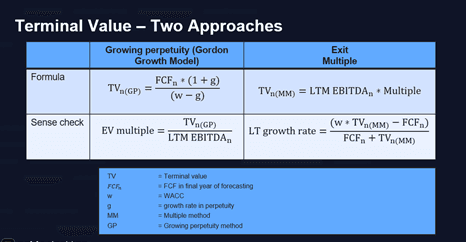
There are two commonly used methods to calculate terminal value—perpetual growth (Gordon Growth Model) and exit multiple.
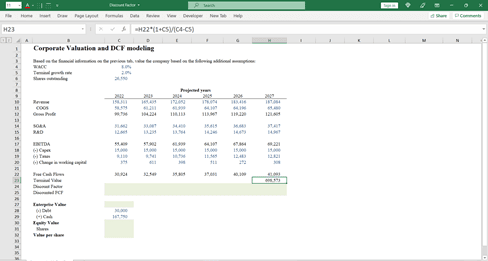
Let’s calculate Terminal Value in our example”
H23 = H22*(1+C5)/(C4-C5)