April 1, 2026/3 min read

Mergers and Acquisitions Financing

Strategic funding approaches for mergers and acquisitions

Core M&A Financing Sources

Equity Financing

Companies can sell equity to raise cash or use stock as currency through stock swaps. This approach helps preserve cash while providing acquisition funding flexibility.

Debt Financing

More challenging for startups but becomes cost-effective during low interest rate periods. Provides leverage without diluting ownership stakes.

Cash Reserves

Using existing cash holdings provides immediate funding without external dependencies. Often combined with other financing methods for larger deals.

M&A financing represents one of the most critical aspects of successful deal execution—the strategic process of securing capital to fund mergers and acquisitions. Whether you're orchestrating a $100 million acquisition or a multi-billion-dollar mega-merger, the financing structure can make or break the transaction. The foundation of any M&A deal rests on three primary funding sources: equity financing, debt financing, and existing cash reserves, each carrying distinct advantages and strategic implications.

The primary sources of M&A financing are:

  • Equity financing

Equity financing in M&A transactions operates through two distinct mechanisms, each serving different strategic purposes. First, the acquiring company can issue new shares to raise fresh capital, diluting existing ownership but providing liquid funds for the acquisition. This approach is particularly valuable when market conditions favor equity issuance and the acquirer's stock is trading at attractive valuations. Second, and increasingly popular among cash-conscious acquirers, is the stock swap—using the company's equity as direct currency to purchase the target's shares. This structure not only preserves precious cash reserves but also allows target shareholders to participate in potential upside from the combined entity. Notable examples include Disney's acquisition of Pixar and Facebook's purchase of Instagram, where stock-heavy deals created significant value for all parties involved.

  • Debt financing

The debt financing landscape has evolved significantly, particularly following the Federal Reserve's monetary policy shifts through 2024-2026. While startups and emerging companies still face challenges accessing debt markets compared to their equity alternatives, established companies with strong credit profiles can leverage historically attractive borrowing conditions. Debt financing offers the compelling advantage of preserving ownership control while providing tax-deductible interest payments. However, the added leverage increases financial risk and requires careful consideration of post-merger cash flow capacity. Senior debt, subordinated debt, and mezzanine financing each play distinct roles in the capital structure, with many acquirers utilizing term loans and revolving credit facilities to maintain flexibility throughout the integration process.

  • A mix of equity and debt financing (most common)
  • Companies may also use their existing cash reserves
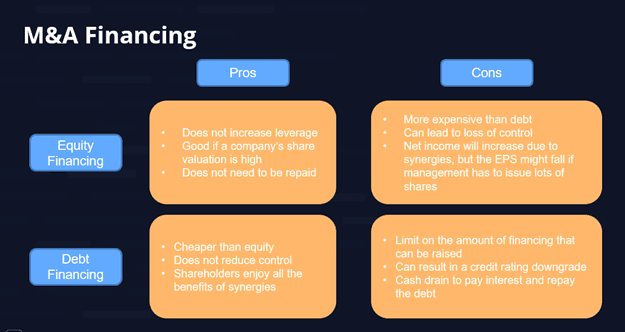
In practice, the most sophisticated acquirers rarely rely on a single financing source. The optimal capital structure typically combines multiple funding mechanisms to balance cost of capital, maintain financial flexibility, and align stakeholder interests. Cash-rich technology giants like Apple and Microsoft often deploy substantial cash reserves accumulated from operations, while private equity firms masterfully orchestrate complex financing structures involving equity commitments, senior debt, and mezzanine capital. The key lies in matching the financing approach to the deal's strategic rationale, the acquirer's financial position, and prevailing market conditions—a decision that ultimately determines both the transaction's feasibility and its long-term success.

Picture1

    Key Takeaways

    1M&A financing primarily relies on three sources: equity financing, debt financing, and existing cash reserves
    2Equity financing can involve either selling company equity for cash or using stock swaps as acquisition currency
    3Stock swaps help acquirers preserve cash by using equity as currency instead of cash payments
    4Debt financing is more challenging for startups but becomes cost-effective during low interest rate periods
    5Mixed financing strategies combining equity and debt are the most common approach for M&A transactions
    6Companies often supplement external financing with their existing cash reserves to complete acquisitions
    7The choice of financing method depends on company maturity, market conditions, and strategic objectives
    8Each financing source has distinct advantages in terms of cost, control, and cash flow impact

    RELATED ARTICLES