April 1, 2026/7 min read

FIFO and LIFO

Master inventory valuation methods for accurate financial reporting

What Makes Up Inventory Costs

Direct Labor

Wages, payroll taxes, pension contributions, and insurance for employees directly involved in product assembly and manufacturing processes.

Direct Materials

All materials and supplies used in manufacturing, including consumed supplies and damaged materials. Any cost varying with each unit qualifies.

Factory Overhead

Manufacturing expenses beyond direct labor and materials, including supervisor salaries, utilities, rent, equipment costs, and depreciation.

Freight and Handling

Transportation costs for delivery plus all preparation activities: picking, packing, labeling, and shipping finished products to customers.

COGS Formula Foundation

COGS = Beginning inventory + Purchases - Ending inventory. This basic formula drives gross profit calculations and directly impacts your company's financial statements and tax obligations.

Inventory represents one of the most critical line items on any manufacturing or retail company's balance sheet, often comprising 20-40% of total assets. For businesses that manufacture or sell physical goods, inventory encompasses the full spectrum of materials required to deliver products to customers: raw materials awaiting processing, work-in-progress items moving through production, and finished goods ready for sale. Understanding how to properly value this inventory isn't just an accounting exercise—it directly impacts profitability, tax obligations, and strategic decision-making.

Costs Included in Inventory Valuation are:

Direct labor: This encompasses all compensation for employees directly involved in manufacturing products, including base wages, overtime premiums, payroll taxes, pension contributions, health insurance, and other benefits. In today's tight labor market, these costs have become increasingly significant, with manufacturing wages rising 15-20% since 2021. Companies must also account for training costs and productivity variations when calculating direct labor components of inventory value.

Direct materials: These include all raw materials, components, and supplies that become part of the finished product or are consumed during manufacturing. This category extends beyond obvious inputs to include seemingly minor items like adhesives, packaging materials, and even materials damaged during normal production processes. The key principle remains unchanged: if a cost varies directly with production volume, it qualifies as a direct material cost. Supply chain disruptions in recent years have made accurate tracking of these fluctuating costs more crucial than ever.

Factory overhead: This broad category captures all manufacturing-related expenses that don't fall into direct labor or materials. Personnel costs include salaries for production supervisors, quality control specialists, maintenance technicians, and materials handlers—essentially anyone who supports production without directly touching the product. Facility costs encompass rent or depreciation on manufacturing space, utilities, insurance, and security. Equipment-related expenses include setup costs, routine maintenance, repairs, and depreciation on machinery. With increasing automation and Industry 4.0 technologies, the depreciation component of factory overhead has grown substantially, while some traditional labor costs have shifted to technology maintenance and programming.

Freight in: Transportation costs to bring materials and goods to your facility represent a direct component of inventory value. This includes not only shipping charges but also customs duties, insurance during transit, and handling fees at ports or distribution centers. Global supply chain complexities have made these costs more variable and significant, particularly for companies sourcing internationally. Companies must distinguish between freight-in (an inventory cost) and freight-out (a selling expense when providing customer shipping).

Handling: These costs cover all activities required to move inventory through your facility and prepare it for customer delivery. This includes warehouse labor for receiving, storing, picking, and packing inventory, as well as the technology systems that support these operations. Modern handling costs increasingly include automation equipment, warehouse management software, and integration with e-commerce platforms that have become essential for competitive fulfillment speeds.

The strategic importance of accurate inventory valuation extends far beyond compliance requirements. It creates the foundation for understanding true product profitability, making informed pricing decisions, and presenting a realistic financial position to investors and lenders. When calculating gross profit on the income statement, companies must subtract cost of goods sold (COGS) from net sales—making inventory valuation methodology a direct driver of reported profitability.

The fundamental COGS calculation remains consistent across industries:

COGS = Beginning inventory + Purchases – Ending inventory

Remember that COGS reflects only the direct costs of producing goods sold during the period. It excludes indirect expenses like marketing campaigns, sales commissions, administrative overhead, and distribution costs—though these expenses significantly impact overall profitability and should be carefully managed alongside COGS.

Inventory Valuation Methods

Inventory valuation methodology represents one of the most impactful accounting policy decisions a company makes, directly influencing reported profitability, tax obligations, and investor perceptions. The method you choose creates a ripple effect through financial statements, affecting everything from gross margins to working capital ratios.

Each of the four primary valuation methods offers distinct advantages and trade-offs. Smart finance leaders evaluate these options not just for immediate financial impact, but for long-term strategic alignment with business goals, tax optimization, and stakeholder expectations.

  • First In, First Out (FIFO). FIFO operates on the logical assumption that businesses sell their oldest inventory first, making it the most intuitive method for most stakeholders to understand. This approach typically assigns lower costs to goods sold (since older inventory was likely purchased at lower prices) and higher values to remaining inventory.

In inflationary environments, FIFO produces higher gross profits and stronger balance sheet presentation, which appeals to investors and lenders evaluating company performance. However, this apparent strength creates two significant challenges: higher taxable income results in increased cash outflows for taxes, and during periods of rapid inflation, FIFO can create a disconnect between current replacement costs and reported COGS, potentially misleading decision-makers about true economic profitability. Given current inflationary pressures, many companies are reassessing whether FIFO still serves their strategic interests.

  • Last In, First Out (LIFO). LIFO assumes that the most recently acquired inventory sells first, creating better matching between current costs and current revenues on the income statement.

This method provides significant tax advantages during inflationary periods by increasing COGS and reducing taxable income—a benefit that can improve cash flow substantially. However, LIFO creates balance sheet distortions by leaving old, potentially obsolete costs in inventory values for extended periods. Additionally, LIFO liquidations (when current production exceeds inventory purchases) can create unexpected spikes in reported profits as old, low-cost inventory flows through COGS. The complexity of LIFO administration and the potential for earnings manipulation have led some companies to abandon this method despite its tax benefits.

  • Weighted Average Cost (WAC). WAC smooths cost fluctuations by using a calculated average of all inventory costs, making it particularly suitable for companies dealing with commoditized products or high-volume, low-differentiation goods. This method reduces the administrative burden of tracking specific cost layers while minimizing profit volatility caused by timing differences between purchases and sales.

WAC works exceptionally well for companies with consistent, predictable cost structures, providing stable gross margin reporting that facilitates better forecasting and budgeting. The primary limitation lies in its inability to reflect the economic reality of specific cost trends—during periods of rapidly changing costs, WAC may not provide the precision needed for optimal pricing and sourcing decisions. Additionally, WAC doesn't offer the tax optimization potential of LIFO or the balance sheet strength of FIFO.

  • Understanding the comparative impact of these methods is crucial for strategic planning. In typical inflationary environments, FIFO generates the highest gross profit margins and strongest inventory valuations, LIFO produces the lowest taxable income and best cash flow from tax savings, while WAC delivers the most stable and predictable financial reporting. These relationships can reverse during deflationary periods, making periodic reassessment essential.
  • Regulatory considerations add another layer of complexity to method selection. While U.S. Generally Accepted Accounting Principles (GAAP) permits all three methods, International Financial Reporting Standards (IFRS) prohibits LIFO entirely. As global business integration continues, companies operating internationally or contemplating expansion must factor these restrictions into their long-term planning. Some multinational corporations maintain different inventory methods for different jurisdictions, though this creates additional complexity and potential confusion.

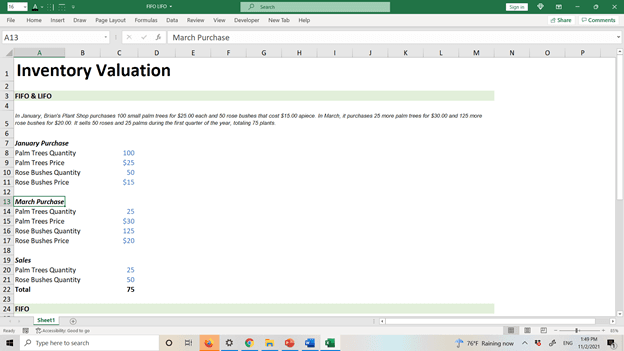
Example:

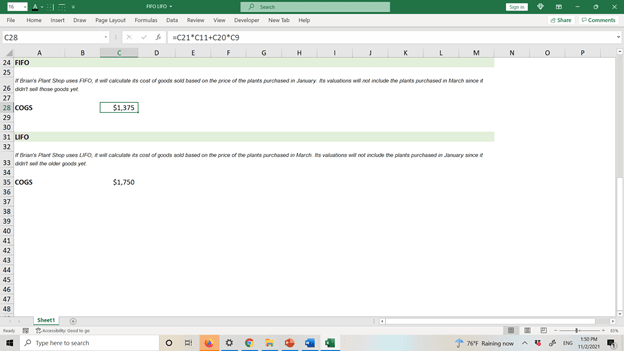
Picture1 Screenshot of an Excel spreadsheet comparing FIFO and LIFO inventory cost methods for a plant shop scenario. The sheet shows formulas calculating cost of goods sold (COGS) at $3,375 under FIFO and $1,750 under LIFO.

FIFO COGS = C21*C11+C20*C9

LIFO COGS = C21*C17+C20*C15

The LIFO calculation demonstrates how this method captures higher current costs in COGS, resulting in lower reported profits but generating substantial tax savings—a trade-off that can significantly improve cash flow, particularly valuable in today's higher interest rate environment where cash conservation has become increasingly strategic.

FIFO vs LIFO vs Weighted Average Comparison

FeatureFIFOLIFOWAC
AssumptionOldest inventory sold firstNewest inventory sold firstAverage cost of all inventory
COGS LevelLowerHigherMiddle
Gross IncomeHigherLowerMiddle
Tax BurdenHigherLowerMiddle
International AcceptanceGAAP and IFRSGAAP onlyGAAP and IFRS
Best ForPerishable goodsNon-perishable goodsIdentical inventory items
Recommended: Choose FIFO for intuitive matching and international compliance, LIFO for tax advantages in inflationary periods, or WAC for simplified tracking of identical items.

FIFO Method Analysis

Pros
Most intuitive and widely used approach
Closely matches actual inventory flow patterns
Accepted under both GAAP and IFRS standards
Lower COGS in inflationary environments
Cons
Results in higher taxable income and tax bills
Can mislead investors during high inflation periods
May not reflect current market conditions in statements

LIFO Method Analysis

Pros
Provides precise matching of current expenses with revenue
Reduces tax burden in inflationary periods
Better reflects current market conditions in COGS
Cons
Shows outdated inventory values on balance sheet
Can keep old costs in inventory accounts for years
Not accepted under International Financial Reporting Standards
Limited to US GAAP compliance only

Weighted Average Cost Analysis

Pros
Simplifies inventory costing and tracking processes
Reduces profit fluctuations from purchase timing
Ideal for businesses with identical inventory items
Eliminates need to track separate purchase costs
Cons
Not sophisticated enough for FIFO or LIFO tracking
May not accurately reflect actual inventory flow
Less precise than specific identification methods
International Compliance Alert

LIFO is allowed under US Generally Accepted Accounting Principles but not under International Financial Reporting Standards. Companies operating internationally must consider this restriction when choosing valuation methods.

FIFO tends to produce the highest gross income during the current period, LIFO the lowest, and WAC something in between.
This relationship assumes a typical inflationary environment where supply costs generally rise over time, directly affecting tax obligations and financial reporting.

Key Takeaways

1Inventory valuation directly affects gross profit calculations and tax obligations through the Cost of Goods Sold formula
2FIFO assumes oldest inventory is sold first, resulting in lower COGS and higher taxable income during inflationary periods
3LIFO assumes newest inventory is sold first, providing better expense matching and tax advantages but showing outdated balance sheet values
4Weighted Average Cost simplifies tracking for identical items but lacks the sophistication for detailed inventory flow analysis
5LIFO is only acceptable under US GAAP, while FIFO and WAC work under both GAAP and International Financial Reporting Standards
6Direct labor, direct materials, factory overhead, freight, and handling costs must all be included in proper inventory valuation
7The choice of inventory method becomes a strategic decision balancing tax efficiency, financial reporting accuracy, and compliance requirements
8In typical inflationary environments, FIFO generates the highest taxes while LIFO produces the lowest tax burden

RELATED ARTICLES