April 1, 2026/2 min read

Free Cash Flow

Master Cash Flow Analysis for Better Investment Decisions

What is Free Cash Flow?

Free cash flow represents the actual cash a company generates after covering operational expenses and capital investments. It's the money available for dividends, debt payments, and growth initiatives.

Free Cash Flow Components

Net Income

Starting point for FCF calculation. Represents company's reported profit after all expenses and taxes.

Non-Cash Expenses

Items like depreciation and amortization that reduce net income but don't involve actual cash outflows.

Working Capital Changes

Adjustments for changes in current assets and liabilities that affect cash position.

Capital Expenditures

Cash spent on maintaining and expanding physical assets necessary for business operations.

Free Cash Flow Calculation Process

1

Start with Net Income

Begin with the company's reported net income from the income statement as your baseline figure.

2

Add Back Non-Cash Expenses

Include depreciation, amortization, and other non-cash charges that reduced net income but didn't involve cash outflows.

3

Adjust for Working Capital

Account for changes in current assets and liabilities that impact the company's cash position.

4

Subtract Capital Expenditures

Deduct cash spent on property, plant, equipment, and other capital investments required to maintain operations.

Free Cash Flow Analysis

Pros
Shows actual cash generation capacity
Better indicator of financial health than net income
Reveals company's ability to fund growth internally
Essential for dividend sustainability analysis
Helps identify companies with strong competitive positions
Cons
Can be volatile from quarter to quarter
May not reflect true profitability
Capital expenditure timing can distort results
Requires careful interpretation of working capital changes
Industry differences make comparisons challenging
Red Flags in FCF Analysis

Consistently negative or declining free cash flow may signal operational challenges, excessive capital requirements, or unsustainable dividend policies that could force costly fundraising or strategic changes.

FCF Investment Analysis Checklist

0/5

Free cash flow (FCF) represents the actual cash a company generates after accounting for essential cash outflows to support operations and maintain its capital assets. Unlike earnings, which can be influenced by accounting assumptions and non-cash items, FCF provides an unvarnished view of a company's ability to generate real money.

  • It represents the cash available for the company to repay creditors, pay dividends and interest to investors, pursue acquisitions, or buy back shares.
  • FCF reconciles net income by adjusting for non-cash expenses (such as depreciation and amortization), changes in working capital, and capital expenditures (CAPEX).

Why FCF Matters More Than Ever: Free Cash Flow has become increasingly critical in today's volatile economic environment. A company with consistently low or negative FCF faces significant constraints—it may be forced into expensive fundraising rounds to maintain solvency, often at unfavorable terms that dilute existing shareholders. Conversely, businesses generating robust FCF enjoy strategic flexibility: they can weather economic downturns, invest opportunistically when competitors struggle, and reward shareholders through dividends or buybacks.

The distinction becomes particularly stark when evaluating growth companies. A firm may show strong revenue growth and positive earnings, but if it's burning through cash to achieve that growth, its long-term viability remains questionable. Companies with sufficient FCF to maintain operations but insufficient cash to reinvest in their business risk falling behind more cash-generative competitors who can fund innovation, expand market share, or acquire strategic assets.

For income-focused investors, FCF serves as the ultimate sustainability metric for dividend payments. A company paying dividends that exceed its free cash flow is essentially borrowing from its future—a practice that's unsustainable over the long term and often signals an impending dividend cut.

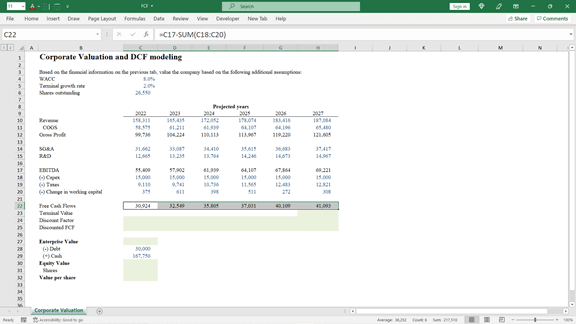
Now, let's examine how to calculate FCF using a practical DCF modeling example that demonstrates these principles in action.

Screenshot of a Microsoft Excel workbook titled 'Corporate Valuation and DCF modeling.' The spreadsheet outlines projected years of revenue, expenses, and EBITDA, along with a section for discounted cash flow calculations, including WACC, terminal growth rate, and enterprise value to derive an implied share price.

Key Takeaways

1Free cash flow measures actual cash generation after operational expenses and capital investments, providing a clearer picture of financial health than net income alone
2FCF calculation involves adjusting net income for non-cash expenses, working capital changes, and capital expenditures to determine true cash availability
3Companies with consistently low or negative FCF may face funding challenges and struggle to maintain operations without external financing
4For dividend-focused investors, FCF analysis is crucial for evaluating payment sustainability and potential for future dividend increases
5Strong FCF generation indicates a company's ability to invest in growth opportunities while maintaining financial flexibility
6FCF volatility requires multi-year analysis to distinguish between temporary fluctuations and underlying business trends
7Capital expenditure timing and working capital changes can significantly impact FCF calculations and require careful interpretation
8Free cash flow serves as a foundation for DCF valuation models and helps investors assess intrinsic company value

RELATED ARTICLES