April 1, 2026/3 min read

Equity Method Accounting

Master Strategic Investment Accounting for Significant Influence

Equity Method Ownership Thresholds

20%
Minimum ownership percentage for significant influence
50%
Maximum ownership percentage before consolidation

Key Equity Method Principles

Significant Influence

Investor holds 20-50% ownership stake in the investee company. This threshold indicates the ability to influence major operating and financial decisions.

Historical Cost Basis

Investment is initially recorded at purchase price. Subsequent adjustments reflect the investor's proportionate share of investee performance.

Income Statement Impact

Investor records their percentage share of investee's net income or loss. This creates a direct link between investee performance and investor results.

Equity Method Recording Process

1

Initial Investment

Record investment at historical cost in the Investments in Associates/Affiliates account as a long-term asset

2

Income Recognition

Increase investment account and record income for the investor's percentage share of investee's net income

3

Dividend Adjustment

Decrease investment account when dividends are received, as this represents cash outflow from the investee

4

Loss Recognition

Decrease investment account and record loss for the investor's percentage share of investee's losses

Investment Valuation Changes

Under the equity method, the investment value fluctuates based on the investee's performance. Net income increases the asset value, while losses and dividend payouts decrease it. This creates a dynamic valuation that reflects the investor's economic interest.

Tiger Inc. Investment Account Changes

Initial Investment
500,000
Share of Net Income
30,000
Dividend Received
-15,000
Ending Balance
515,000

Tiger Inc. Example Breakdown

FeatureTransactionAmount
Initial Investment CostPurchase 30% of Panther Corp$500,000
Panther's Net IncomeTotal reported income$100,000
Tiger's Share of Income30% of net income$30,000
Panther's Total DividendsPaid to all shareholders$50,000
Tiger's Dividend Received30% of total dividends$15,000
Final Investment ValueYear-end balance$515,000
Recommended: The $15,000 net increase represents Tiger's 30% share of Panther's retained earnings ($50,000 net income minus $50,000 dividends = $0 retained, but Tiger benefits from the income recognition)
Retained Earnings Reconciliation

The investment account change reconciles with the investor's portion of retained earnings. Panther's retained earnings increased by $50,000 (net income minus dividends), and Tiger's 30% share equals the $15,000 net increase in their investment account.

Equity Method Implementation Checklist

0/6

  • The equity method serves as the accounting standard for valuing a company's investment in another entity when it wields significant influence—typically defined as having meaningful input into operational and financial decisions without exercising full control
  • Generally Accepted Accounting Principles (GAAP) establish the threshold for "significant influence" at 20-50% ownership, though qualitative factors such as board representation or management agreements can also trigger this classification
  • Under the equity method framework, investments are initially recorded at historical cost, then systematically adjusted to reflect the investor's proportional share of the investee's net income, losses, and dividend distributions
  • When the investee generates net income, the investor's asset value increases proportionally on their balance sheet; conversely, losses or dividend payments reduce this carrying value, creating a dynamic reflection of the investee's performance
  • Crucially, the investor must also recognize their proportional share of the investee's net income or loss directly on their own income statement, ensuring earnings transparency across both entities
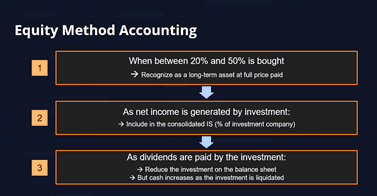
Infographic titled 'Equity Method Accounting' showing three steps: (1) When buying between 20% and 50%, record the investment as a long-term asset at full price, (2) Include the proportion of net income in the consolidated income statement, and (3) Reduce the balance sheet investment when dividends are paid, while cash balance increases.

To illustrate how these principles work in practice, consider this comprehensive example that demonstrates each key aspect of equity method accounting.

Example:

Tiger Inc. acquires a 30% stake in Panther Corp for $500,000, establishing significant influence over the investee company. At year-end, Panther Corp reports net income of $100,000 and distributes $50,000 in total dividends to all shareholders.

The initial transaction follows standard equity method protocol: Tiger records its investment under "Investments in Associates/Affiliates," a long-term asset account that will fluctuate based on Panther's performance. This $500,000 investment represents Tiger's cost basis and serves as the starting point for all subsequent adjustments.

When Panther distributes dividends, Tiger receives $15,000 (representing its 30% ownership share of the $50,000 total distribution). Critically, this dividend receipt reduces Tiger's investment account rather than appearing as dividend income. This accounting treatment reflects the economic reality: dividends represent a return of the investee's equity, effectively transferring value from the investee to the investor and reducing the underlying investment's carrying value.

Simultaneously, Tiger must recognize its proportional share of Panther's operational performance. Since Panther generated $100,000 in net income, Tiger records $30,000 (30% × $100,000) as an increase to both its Investment account and its own income statement. This ensures that Tiger's financial statements capture the economic benefits of Panther's profitability, even though no cash changes hands.

The mathematical reconciliation demonstrates the method's internal logic: Tiger's investment account ends the year at $515,000, reflecting a net increase of $15,000 from the original $500,000 cost. This $15,000 gain precisely matches Tiger's share of Panther's retained earnings increase. Panther's $100,000 net income, reduced by the $50,000 dividend distribution, generated $50,000 in additional retained earnings. Tiger's 30% share of this retention equals $15,000—exactly matching the investment account's year-end increase and confirming the accuracy of the equity method calculations.

Key Takeaways

1The equity method applies when an investor holds 20-50% ownership, indicating significant influence over the investee company
2Initial investment is recorded at historical cost in the Investments in Associates/Affiliates long-term asset account
3The investor's share of investee net income increases both the investment account value and the investor's reported income
4Dividend receipts from the investee decrease the investment account balance, as they represent cash outflows from the invested company
5Investment account changes must reconcile with the investor's proportionate share of the investee's retained earnings changes
6Both balance sheet investment values and income statement results fluctuate based on the investee's financial performance
7The equity method creates a direct economic link between investor and investee financial results through proportionate recognition
8Proper equity method accounting requires ongoing monitoring of the investee's income, losses, and dividend distributions

RELATED ARTICLES