Consolidated Financials
Consolidation Basics
Parent + Subsidiaries
Combine financials of parent and majority-owned subsidiaries into one set.
Eliminate Intercompany
Cancel out internal sales and receivables — only external transactions remain.
Non-Controlling Interest
Portion of subsidiary not owned by parent — separate equity line.
Required for Public Companies
GAAP and IFRS both mandate consolidated reporting for control relationships.
Noble Desktop's Financial Analyst Training Program covers financial modeling, valuation, accounting, and Excel for finance.
Explore the intricacies of consolidated financial statements, from their role in representing a corporation's multiple divisions to the criteria for filing, and understand the process for creating such statements according to GAAP and IFRS provisions.
Consolidated financial statements are financial statements of an entity with multiple divisions or subsidiaries
Consolidated financial statements are strictly defined as statements collectively aggregating a parent company and subsidiaries
GAAP and IFRS include provisions that help to create the framework for consolidated subsidiary financial statement reporting
If a company doesn’t choose to use consolidated subsidiary financial statement reporting it may account for its subsidiary ownership using the cost method or the equity method
In general, the consolidation of financial statements requires a company to integrate and combine all of its financial accounting functions together to create consolidated financial statements that show results in the standard balance sheet, income statement, and cash flow statement reporting.
The criteria for filing a consolidated financial statement with subsidiaries are primarily based on the amount of ownership the parent company has in the subsidiary. Generally, 50% or more ownership in another company usually defines it as a subsidiary and gives the parent company the opportunity to include the subsidiary in a consolidated financial statement. In some cases, less than 50% ownership may be allowed if the parent company shows that the subsidiary’s management is heavily aligned with the decision-making processes of the parent company.
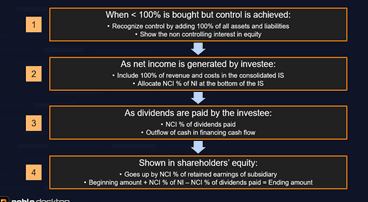
We will take a closer look at Income Statement and Balance Sheet Consolidation in the following videos.
1Full Video Transcript
2Definition of Consolidated Financial Statements
Consolidated financial statements are financial statements of an entity with multiple divisions or subsidiaries, strictly defined as statements collectively aggregating a parent company and subsidiaries. GAAP and IFRS include provisions that help to create the framework for consolidated subsidiary financial statement reporting.
If a company doesn't choose to use consolidated subsidiary financial statement reporting, it may account for its subsidiary ownership using the cost method or the equity method. In general, the consolidation of financial statements requires a company to integrate and combine all of its financial accounting functions together in order to create consolidated financial statements that show results in standard balance sheet, income statement, and cash flow statement reporting.