April 1, 2026/2 min read

Balance Sheet Consolidation

Master Financial Statement Integration and Subsidiary Consolidation

What is Balance Sheet Consolidation

Consolidation refers to the incorporation of the financial statements of all subsidiaries into the financial statements of the parent company, creating unified financial reporting.

Key Components of Consolidated Statements

Income Statement

Combined revenue, expenses, and profit/loss from parent and all subsidiaries. Eliminates intercompany transactions to avoid double counting.

Balance Sheet

Unified assets, liabilities, and equity positions. Requires careful elimination of intercompany balances and investments.

Cash Flow Statement

Consolidated operating, investing, and financing activities. Shows the true cash position of the entire corporate group.

Balance Sheet Consolidation Process

1

Gather Balance Sheet Values

Collect the balance sheet data from both the investor (parent company) and investee (subsidiary) entities.

2

Add Values Together

Combine corresponding line items from both balance sheets to create preliminary consolidated figures.

3

Apply Transaction Effects

Make necessary adjustments for intercompany transactions, eliminations, and consolidation entries to avoid double counting.

Consolidation Formula

Consolidated Balance Sheet = Parent Company Balance Sheet + Subsidiary Balance Sheet - Intercompany Eliminations + Consolidation Adjustments

Pre-Consolidation Requirements

0/4

Benefits and Challenges of Consolidation

Pros
Provides complete financial picture of the corporate group
Enables better decision-making with unified reporting
Required by accounting standards for public companies
Improves transparency for investors and stakeholders
Cons
Complex process requiring specialized expertise
Time-consuming with multiple subsidiaries
Potential for errors in elimination entries
May obscure individual subsidiary performance

Standalone vs Consolidated Reporting

FeatureStandalone StatementsConsolidated Statements
ScopeSingle entity onlyParent plus all subsidiaries
Investment TreatmentShows investment in subsidiariesEliminates investment, shows underlying assets
Intercompany TransactionsIncluded as external transactionsEliminated to avoid double counting
User PerspectiveEntity-specific performanceGroup-wide financial position
Recommended: Consolidated statements provide the most complete view for investors and regulatory compliance.

Balance Sheet Consolidation

Balance sheet consolidation represents one of the most critical processes in corporate finance, requiring the systematic integration of subsidiary financial statements into the parent company's comprehensive financial picture. This sophisticated accounting procedure goes beyond simple addition—it demands a deep understanding of intercompany relationships, equity ownership structures, and complex financial instruments.

The consolidation process transforms disparate financial data from multiple entities into a unified set of financial statements that accurately reflect the economic reality of the entire corporate group. Modern regulatory frameworks, including updated GAAP and IFRS standards as of 2026, require parent companies to present consolidated income statements, balance sheets, and cash flow statements that eliminate intercompany transactions while properly accounting for non-controlling interests and goodwill adjustments.

Understanding balance sheet consolidation has become increasingly vital as global business structures grow more complex, with multinational corporations managing intricate webs of subsidiaries, joint ventures, and special purpose entities. The following video breaks down this essential financial concept with practical applications.

———————————

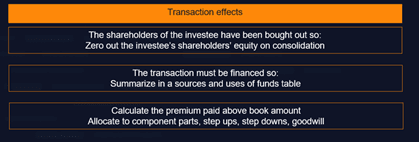
The mechanics of consolidated balance sheet creation follow a systematic approach that begins with aggregating the individual balance sheet values of both the investor (parent company) and investee (subsidiary). However, the real complexity emerges in the subsequent transaction effects phase, where accountants must carefully adjust for acquisition premiums, fair value adjustments, and the elimination of intercompany balances. This process requires meticulous attention to detail, as even small errors can significantly distort the consolidated entity's apparent financial position and mislead stakeholders about the true economic performance of the combined organization.

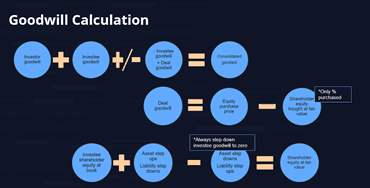
Picture1Illustration labeled 'Goodwill Calculation' showing a flow of circles and equations. It starts with investor goodwill and investee goodwill, combines them to form deal goodwill, and ultimately calculates consolidated goodwill. Additional steps depict how equity purchase price, shareholder equity, and asset step-downs factor into the final goodwill figure.

To demonstrate these principles in action, we'll examine a comprehensive example of balance sheet consolidation using Excel in the accompanying video tutorial. This hands-on approach will illustrate how theoretical consolidation concepts translate into practical financial modeling techniques that you can immediately apply in your professional work.

Key Takeaways

1Balance sheet consolidation combines parent company and subsidiary financial statements into unified reporting
2The process involves adding balance sheet values together and applying necessary transaction effects and eliminations
3Consolidated statements include integrated income statement, balance sheet, and cash flow statement
4Intercompany transactions must be eliminated to prevent double counting and provide accurate financial position
5Parent companies must have controlling interest in subsidiaries to require consolidation
6Standardized accounting policies and aligned reporting periods are essential for accurate consolidation
7Consolidated reporting provides stakeholders with complete financial picture of the entire corporate group
8The consolidation process requires careful attention to elimination entries and consolidation adjustments

RELATED ARTICLES