April 1, 2026/3 min read

Exchange Ratio

Understanding Share Value in Mergers and Acquisitions

Key Concept

Exchange ratio determines how many new shares existing shareholders receive when their company is acquired or merged, maintaining equivalent relative value in the new entity.

Exchange Ratio Components

Share Calculation

Determines the number of new shares issued for each existing share. Based on relative valuations of merging companies.

Value Preservation

Ensures shareholders maintain equivalent economic interest in the merged entity. Accounts for control premiums and intrinsic values.

Control Premium

Additional value paid by acquirer for gaining complete control. Often included in target company purchase price calculations.

Fixed vs Floating Exchange Ratios

FeatureFixed Exchange RatioFloating Exchange Ratio
Ratio StabilityFixed until deal closesAdjusts with price changes
Share CountKnown quantityVariable quantity
Deal ValueUnknown final valueFixed deal value
Control PercentageKnown for acquirerVariable for acquirer
Preferred ByAcquiring companyTarget company
Recommended: Choice depends on market conditions and negotiating priorities of each party.

Fixed Exchange Ratio Analysis

Pros
Acquiring company knows exact number of shares to issue
Control percentage is predetermined and certain
Simplifies governance planning for merged entity
Reduces execution complexity for acquirer
Cons
Final deal value remains uncertain until closing
Target shareholders bear market risk during deal period
May require price adjustments if market conditions change significantly

Floating Exchange Ratio Analysis

Pros
Target company receives guaranteed fixed value
Protection against adverse market movements
Seller certainty enables better financial planning
Eliminates valuation risk for target shareholders
Cons
Acquirer cannot predict final share dilution
Control percentage remains variable until closing
Increased complexity in deal structuring and approvals

Exchange Ratio Calculation Process

1

Determine Base Values

Establish current market values and intrinsic valuations for both acquiring and target companies using multiple valuation methodologies.

2

Apply Control Premium

Add appropriate control premium to target company valuation to reflect the value of obtaining complete ownership and control.

3

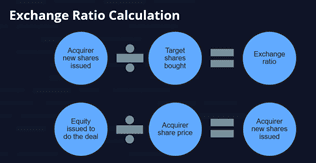
Calculate Share Exchange

Divide adjusted target value by acquirer share price to determine number of acquirer shares needed per target share.

4

Validate Relative Value

Verify that shareholders receive equivalent economic value in the merged entity compared to their original investment.

Excel Implementation

The formula C11=C8*(1+C9)*C10 calculates adjusted target value with premium, while C12=C11/B8 and C13=C12/C10 determine the final exchange ratio per share.

Exchange Ratio Evaluation Checklist

0/5

The exchange ratio represents the critical mathematical foundation of any stock-based merger or acquisition—determining exactly how many new shares existing shareholders will receive when their company is acquired or merges with another entity. This ratio ensures that shareholders maintain equivalent economic value in the combined company, serving as the bridge between their old investment and their stake in the newly formed organization. In today's dynamic M&A environment, where deal structures have grown increasingly sophisticated, understanding exchange ratios is essential for investors, executives, and financial professionals alike.

  • The exchange ratio calculates precisely how many shares an acquiring company must issue for each share an investor owns in a target company, ensuring the investor receives equivalent relative value in the transaction.
  • The target company's purchase price typically includes a control premium—often ranging from 20% to 40%—paid by the acquirer for gaining complete operational control of the target company.
  • Multiple valuation methodologies, including discounted cash flow analysis, comparable company metrics, and strategic synergies, inform the determination of an appropriate exchange ratio.
  • Exchange ratios fall into two fundamental categories: fixed exchange ratios and floating exchange ratios, each serving different strategic purposes and risk preferences.

Understanding these two structural approaches is crucial for evaluating any stock-based transaction.

A fixed exchange ratio remains constant from announcement through deal closure, providing certainty around share issuance but leaving the ultimate transaction value subject to market fluctuations. Under this structure, if Company A agrees to issue 1.2 shares for every share of Company B, that ratio holds regardless of subsequent stock price movements. Acquiring companies typically favor this approach because it provides predictable ownership dilution and maintains clarity around post-merger control dynamics. However, this structure places market risk squarely on target company shareholders, who may see their deal value erode if the acquirer's stock price declines during the regulatory approval period.

A floating exchange ratio adjusts dynamically to preserve a predetermined transaction value, regardless of stock price volatility between signing and closing. This mechanism protects target shareholders by guaranteeing they receive a specific dollar amount, though the exact number of shares they'll own in the combined entity remains uncertain until deal completion. Target companies and their shareholders generally prefer floating ratios because they eliminate market timing risk and provide valuation certainty. The tradeoff is complexity in deal documentation and potential challenges in securing shareholder approval when the final ownership structure remains undefined.


To illustrate how these calculations work in practice, consider this Excel-based example that demonstrates the mathematical mechanics underlying exchange ratio determination:

Picture1

Excel Example:

C11=C8*(1+C9)*C10

C12=C11/B8


C13=C12/C10
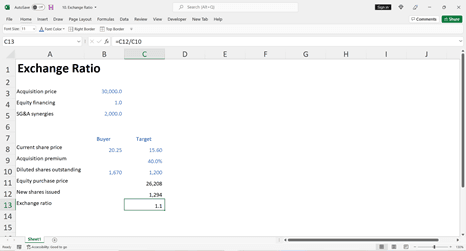
Screenshot of an Excel workbook titled 'Exchange Ratio, ' displaying acquisition-related data such as acquisition price, synergies, share prices, outstanding shares, newly issued shares, and a calculated exchange ratio (1.1) based on the formula =C12/C10.

Ultimately, an exchange ratio serves as the fundamental mechanism ensuring that shareholders receive proportionate value when transitioning from their original investment to ownership in the acquiring or merged entity. The sophistication of modern M&A transactions—particularly in sectors like technology and healthcare where valuations can shift rapidly—makes precise exchange ratio calculation more critical than ever. Whether structured as fixed or floating, these ratios must balance the competing interests of acquirer control, target shareholder protection, and deal completion certainty in an increasingly complex regulatory and market environment.

Key Takeaways

1Exchange ratios determine the number of new shares existing shareholders receive in mergers and acquisitions to maintain equivalent relative value
2Fixed exchange ratios provide certainty on share count and control percentage for acquirers but create uncertainty on final deal value
3Floating exchange ratios guarantee fixed deal value for target companies but create share dilution uncertainty for acquirers
4Control premiums are typically included in target company valuations to reflect the value of obtaining complete ownership
5Both intrinsic company value and underlying asset value must be considered when establishing appropriate exchange ratios
6Acquiring companies generally prefer fixed ratios for control certainty while target companies favor floating ratios for value certainty
7Exchange ratio calculations involve adjusting target value with premiums then dividing by acquirer share price
8The choice between fixed and floating ratios depends on market conditions, volatility expectations, and negotiating priorities of each party

RELATED ARTICLES